Showing posts with label Steven Moffat. Show all posts

Monday, 2 April 2018

A Christmas Carol review [Steven Moffat]

On Christmas Eve, the Doctor must convince resident miser Kazran Sardick to save a crashing spaceship with 4,003 people aboard, Amy and Rory Williams amongst them. How best to do this? Why, rewriting his entire life's history, of course.

The Doctor's Case:
  • A Good Quotation:
    • "Where's Mrs Mantovani?" / "Ah, you'll never guess. Clever old Mrs Manto. She only went and won the lottery." / "There isn't any lottery." / "I know! What a woman!"
  • The title and Michael Gambon's obvious Scrooge that we meet at the beginning of the episode ("I despise Christmas") together set up a predictable and cliche Christmas special with the Doctor time-travelling around with a humbug showing him the error of his ways before he decides he loves Christmas. Fortunately, this isn't what we got. Kazran's not a complete Scrooge, having some small degree of decency that the Doctor spots and which prompts him to build Kazran into a better man to save a crashing space-ship.
  • Kazran quickly turns out to be a far more interesting character than first expected, with all three of his actors doing superb work. Here's hoping for an Eleventh and Kazran Big Finish box set.
  • The fish sound ridiculous but watching the episode they make sense. They're an obvious way to try to weave Katherine Jenkins's voice into the episode somehow but they're still a nice idea.
  • The Doctor serving as the Ghost of Christmas Past is the best sequence of the episode, where we explore Kazran and follow his growing affections for Abigail. More interesting, though, is his transformation from a sweet boy to a love-struck young man to a bitter miser, even if the reason behind Abigail's countdown is obvious. Amy as the Ghost of Christmas Present is fine, although we don't have any real emotional connection to anyone on the ship but perhaps her and Rory. The Ghost of Christmas Future, however, turns out to be Kazran himself, who angrily goes to strike his past-self before remembering his father.
The Valeyard's Case:
  • A Bad Quotation:
    • "Father Christmas. Santa Claus. Or, as I've always known him, Jeff."
  • In The Aztecs (a great story) Barbara decides to end the religion of the Sun God to protect the culture from the landing of Cortez. The Doctor says to her, "But you can't rewrite history! Not one line!" Yet here the Doctor does so, rewriting most of Kazran's biography, in fact. Not only is he going against what he said and has, more often than not, stood by but in changing the course of this man's life he's playing God. The Time Lord Victorious.
  • Surely given that the Doctor is rewriting time, reality should be changing rather than old Mr Sardick remembering new things and being aware of temporal changes (e.g. the painting of his father being replaced by and then replacing one of Abigail).
  • Kazran starts off as a very nasty man, yes, but his willingness to let 4,003 people die without so much as a thought does come across as cartoonish and moustache-twirling. We know that he's a bad guy but it makes him somewhat difficult to buy into.
  • The Doctor learns that the Sardicks have amassed a collection of people as insurance and does nothing. He doesn't bring up how people aren't a commodity or that the lives of these people have been put on hold whilst their families suffer their absence. He doesn't release any of them but Abigail. Any other Doctor would have been disgusted by what they'd seen and freed everyone.
  • There doesn't feel like there's much of a threat in this episode with regards to the crashing space-ship. We're told that there are more than 4,000 people aboard but all we see is the cockpit with Amy, Rory and a small handful of crew members. A sweeping shot or two of the people inside the ship might have helped as it feels so small.
  • Katherine Jenkins's performance is fine but Abigail Pettigrew isn't much of a character. Perhaps Moffat deliberately underwrote Abigail to avoid giving Katherine Jenkins too much material given that it's her first acting job. She's happy to spend the last few days of her life with two strangers than to return to her family. Why?
I'll Explain Later:
  • Abigail is dying. Is she really that useful as insurance when she has only a week to live?
  • What space disease does Abigail have that shows no symptoms up until the very day she dies?
  • Hopefully the delta wave in the fog caused by Abigail's voice isn't the same kind of delta wave the Ninth Doctor planned to use to destroy Earth in Bad Wolf.
The Inquisitor's Judgement: Overall, this is a flawed but decent Christmas special - probably amongst the best of the festive specials. Occasionally the Doctor's fast-talking quirkiness irritates and Abigail isn't a fully-formed character, but the character of Kazran manages to make A Christmas Carol a touching story that avoids most of the cliches derived from its source material. B


Doctor Who (Series 6)
The Pandorica Opens/The Big Bang  A Christmas Carol  The Impossible Astronaut

Monday, 15 January 2018

The Beast Below review [Steven Moffat]

"In bed above we're deep asleep, while greater love lies further deep. This dream must end, this world must know. We all depend on the beast below." - Amy Pond
The Eleventh Doctor finally takes Amy into outer space after all her years of waiting. Starship UK flies past the TARDIS and the Doctor decides to land, unaware of the conspiracies, torture and murder occurring below.
The Doctor's Case:
  • The episode begins with an amazing pre-credits sequence. The opening shot of Starship UK is breath-takingly atmospheric, and seeing the Union Flag and the buildings saying "Surrey" and the like is intriguing. London's forty decks below? Children are given scores at the end of the school day that determine what they can do? A child is dropped from a lift to the beast below? It immediately stirs interest in the world we're soon to be dropped into.
  • The Doctor claiming that he doesn't involve himself in the affairs of other worlds is funny enough on its own, but him popping up on the scanner and beckoning Amy to him is very amusing. He cleverly works out that there are no engines and his analysis of the crying girl is, whilst something one could easily imagine the Tenth Doctor doing, a good example of the Doctor's detective skills.
  • A spaceship that couldn't possibly fly is in flight. Voting booths that impart information and allow you to protest or forget. Moffat quickly sets up an interesting mystery.
The Valeyard's Case:
  • This is our first adventure out in space with the Eleventh Doctor and yet in the climax we see him being unpleasant to Amy, shouting at her and telling her that he'll be taking her home, and saying that very soon he'll have to find a new name for himself. Whilst nowhere near as bad as The Twin Dilemma, it's not a great idea to be showing the new Doctor in this sort of light this early on. The Doctor should be the one to save the day.
  • Amy being held out of the TARDIS isn't quite as magical as it should be. When Donna opened the doors and gazed out in The Christmas Invasion, it was wondrous. Perhaps because we've seen it before or because it could have been shot better, Amy's reaction leaves a lot to be desired. 
  • In fact, Amy takes it all in her stride far too easily. She arrives on an alien world and in the space of a few seconds she frantically remarks how far into the future she is and how she's been dead for centuries, then she's over it. We got some lovely scenes between the Ninth Doctor and Rose about these subjects in The End of the World and whilst recycling them would be dull they could be refreshed and given a new perspective. Karen Gillan's rapid-fire delivery doesn't help very much, making these sentiments just words rather than her character's worries. She finds out she's in a police state and the Doctor leaves her alone and she's absolutely fine.
  • Liz Ten is somewhat flat most of the time, failing to convince as a queen distrusting her own government. When waving her guns about she reminds one of River Song. Or, rather, the psychopath River Song that the genial archaeologist from Silence in the Library will become this series.
  • The Doctor makes a creature audible and is then asked to stop it. This was done better and with far more emotion in Planet of the Ood. Also, will the star whale really want to continue flying Starship UK after two centuries of unending torture?
His Constant Companion: Protesters are dropped from the voting booths into the star whale's mouth, where they're eaten.

I'll Explain Later:
  • How is Liz Ten unaware that she's so old? Have the population not told her that her reign's lasted two centuries? It seems very strange that she would have no idea about this.
  • If Scotland left, why is the Union Flag still whole? Surely St Andrew's cross should have gone with the Scots.
The Inquisitor's Judgement: Despite a very promising teaser, The Beast Below doesn't quite deliver what it promises. C


Doctor Who (Series 5)
The Eleventh Hour  |  The Beast Below  |  Victory of the Daleks

Tuesday, 19 December 2017

The Eleventh Hour review [Steven Moffat]

"Basically, run." - The Doctor
After his most violent regeneration yet, the Doctor lands in the back garden of a Scottish girl with a crack in the fabric of reality in her bedroom wall.

Matt Smith is the Doctor.
The Doctor's Case:
  • Christopher Eccleston is awkward at times in Rose when asked to be quirky. David Tennant fails to give the Tenth Doctor a real identity until almost halfway into series 2. Almost every leading man has needed at least their first story to come to grips with who their Doctor is and how they're going to play it. Peter Davison admitted he had no idea what he was doing and just walked around smiling in Four to Doomsday. Wisely, The Eleventh Hour was held off until The Beast Below through The Time of Angels/Flesh and Stone had been filmed, meaning that Matt Smith is marvellous from the off, slipping into the shoes of the Doctor so easily that it's easy to forget that those Converse had another man in them just an episode ago. Matt Smith isn't one of my favourite Doctors but his performance in this story is sterling and quite possibly his best in the role, later becoming almost caricatured by the time of his departure. We'll discuss that later.
  • The up-and-down regenerative trauma set the Sixth Doctor off on the wrong foot as a schizophrenic coward in The Twin Dilemma, made the Seventh Doctor look ridiculous in Time and the Rani and made it difficult to get a feel for Twelfth in Deep Breath. Moffat chooses to largely forego the Eleventh Doctor's regeneration sickness after the food sequence. This was a clever choice, letting us get a feel for who this new Doctor is, which was an issue with having the Tenth Doctor bed-bound for most of The Christmas Invasion
  • The Doctor meeting a girl only to come back to find her a woman happened in The Girl in the Fireplace but it's explored more here with Amy Pond, the first primary companion to hail from somewhere other than London since Grace Holloway. This is a refreshing change as London had become far too prevalent in the show. Unfortunately we'll be returning there when Amy and Rory move and then again with Clara in The Bells of St John. Let's enjoy the small-town vibe of Leadworth while we can, the only place in the UK that isn't London or Cardiff.
The Valeyard's Case:
  • Opening with the zoom-in on Earth again? It had a purpose in Rose, but it doesn't here. It's much too quick and, by this point, unimpressive.
  • Amy pretends to be an English policewoman for no other reason than to throw off the audience.
  • The CGI of Prisoner Zero isn't very good at all, particularly in the scene where it hides over Amy's shoulder. How does it get around, anyway? It seems to be permanently attached to the ceiling when not in human form.
  • The "what did I see?" sequence is unnecessary and ridiculous and eats up both money and time.
  • It wouldn't have taken a moment for Rory to show the pictures of the coma patients to Dr Ramsden. Why not do it before his dismissal? Any reasonable person would have.

A Good Quotation: "So, all of time and space, everything that's ever happened or ever will. Where do you want to start?" (The Doctor)

When Are We?: The majority of the episode takes place in 2008, with the Doctor meeting Amelia Pond in 1996 and Amy joining him in 2010. This episode takes place almost immediately after The End of Time and just before The Beast Below.

This Reminds Me...:
  • The Doctor previously stole clothes from a hospital after regenerating in Spearhead from Space and The Movie.
His Constant Companion: Dr Ramsden and the nurses are presumed to have been killed by Prisoner Zero.

I'll Explain Later:
  • Amy doesn't have a car and she lives in a tiny village where everyone knows one another. How does she have a career as a kissogram?
  • Why did the coma patients all say "Doctor"?
The Inquisitor's Judgement: It's rare for a new Doctor to get a great first story but this one is really very good. It's a little thin on plot but getting to see the new Doctor in action rather than suffering regeneration sickness, being unlikeable or being bedbound. Young Amelia Pond is a good character and the older Amy is good too, perhaps at her best here (having a bit more to her than sexuality and sarcasm), and her fairytale relationship with the Doctor is well-done. The Eleventh Doctor had the potential to be one of my favourite Doctors after I first watched this episode and, whilst that didn't come to be the case, it's still a fantastic performance in a decent story. I'd rank this episode at an A.

Doctor Who (Series 5)
The End of Time  |  The Eleventh Hour  The Beast Below

Saturday, 24 June 2017

The Pilot review [Steven Moffat]

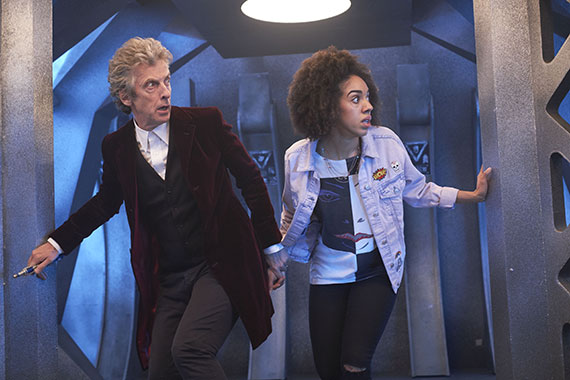
The Doctor and his new companion Bill Potts.
Bill Potts is a lunch-lady at St Luke's University in Bristol who sneaks into the interesting and unusual lectures of the Doctor, who's been teaching there for at least fifty years without ageing. One day she's called to his office and offered the chance to be his personal tutee. But who is this mysterious man? Why does he have a '60s police box in his office? And what has he been doing here all these years?

The first episode of Steven Moffat's final series, he marks this episode as a jumping-on point in the same vein as 'Rose'. Cheekily named, will this episode be a fresh start for the show?

Spoiler Zone

The episode

Yes, more or less. Key concepts are explained in a way that's welcoming to newcomers and aside from Nardole's presence, the photographs of Susan and River and a visit to the Dalek-Movellan war there's very little baggage to this episode. Having the episode be from Bill's point-of-view rather than the Doctor's crafts the Doctor as more of a mysterious and unknowable character again. Moffat definitely succeeded in making the episode a jumping-on point. The show hasn't been this accessible to newcomers since 'The Eleventh Hour' and Bill's entrance to the TARDIS will go down in history.

Bill is a wonderful companion, asking questions of a different type and being funny without being annoying. She's a regular person, like Rose, Martha or Donna, rather than a smug and unrelatable Amy Pond or soulless like Clara Oswald. The Doctor, meanwhile, is no longer the brash and prickly Doctor of season eight or the slightly embarrassing Doctor of season nine. He's a far more interesting and likeable character now, and only one episode in the relationship between Doctor and companion has been cemented. He's a lecturer now and tethered to Earth like the Third Doctor was. which might make for an interesting theme. He clearly wants to be exploring new worlds, but he's instead stuck on Earth, delivering lectures that are nonsensical.

The idea with the puddle is initially an interesting one but isn't particularly groundbreaking. The relationship between the Doctor and Bill is definitely the most important part of the episode with the villain playing second fiddle, but that's fine. Bill and Heather's relationship was rushed and impossible to buy into, not helped by the fact that Heather is an unlikeable character, seeming moody and rude. The Dalek appearance was entirely unnecessary and the vault fails to be intriguing given how tiringly long it took for the cracks in time to be revealed or the identities of the hybrid or Missy to be explained.

A good quotation

Bill: Why do you run like that?
The Doctor: Like what?
Bill: Like a penguin with its arse on fire.

TARDIS crew and co.

  • The Doctor: "Time and relative dimension in space. It means, what the Hell?" The Doctor has photographs of his granddaughter Susan and his wife River on his desk, but when Bill asks if photos really help the implication is that they don't. He decides not to erase Bill's memory, remembering what happened with Clara in 'Hell Bent'.
  • Bill Potts: "What good is getting in your box going to do?" Bill is a fan of science fiction, eager to learn and desperate for adventure. She's a lesbian and lives with her foster mother Moira. Her mother died when she was a baby and Bill has very few photographs of her.
  • Nardole: "Sir, we're leaving Earth. What about the vault?" Nardole (whose body is at least partly robotic, it seems) is working as the Doctor's valet at St Luke's. His real job is keeping the Doctor in line and making sure he remains on Earth, protecting the vault.

Plot holes and continuity

  • The Daleks had their Time War tanks during the Dalek-Movellan war?
  • Was the Doctor supposed to be protecting the vault in 'The Return of Doctor Mysterio'? Nardole had no problem with him being in New York.

Popular posts