Showing posts with label Series 5. Show all posts

Sunday, 17 June 2018

The Pandorica Opens/The Big Bang review [Steven Moffat]

A Steven Moffat two-parter. We've had The Empty Child/The Doctor DancesSilence in the Library/Forest of the Dead and The Time of Angels/Flesh and Stone, which count amongst the very best of modern Doctor Who. How will this one compare?

The Doctor's Case:
  • A Good Quotation:
    • "You graffitied the oldest cliff-face in the universe." / "You wouldn't answer your phone."
    • "What's it short for? Roranicus?"
    • "Hi, honey. I'm home." / "And what sort of time do you call this?"
    • "I'm River Song. Check your records again."
    • "Where's the Dalek?" / "It died."
    • "Not to you?" / "He doesn't really know me yet. Now he never will."
  • We've seen the Eleventh Doctor foster a friendship with a little Scottish girl. We've seen him come to the rescue of Dr River Song and begin peace talks with Silurians and move in with Craig Owens. Now we get to see him take on something grander and potentially universe-ending and Matt Smith does a very good job as usual. He seemed to struggle a little early in the series, but by this point he's definitely the Doctor. The speech at Stonehenge is wonderfully delivered (even if I can't help but wonder why he's not shot to smithereens - they won't shoot him but will lock him up and leave him unguarded?).
  • Dr Song isn't as interesting as she was in her previous appearances, but this episode doesn't focus very much on her so this is understandable. After showing the painting to the Doctor, she's just one of his companions who happens to be able to fly the TARDIS (somewhat like Nyssa in that regard), which isn't necessarily a bad thing - we don't need to spend every one of her appearances wondering who she is. There's no hint of the smugness that would come to overtake her character and which was visible to a much smaller degree in her first two stories. Her escape from the Stormcage is a good scene and the stick-figure being held at gunpoint is funny.
  • Seeking to contend with the extraordinary opening of The Time of Angels, we get a teaser that sprawls space and time. It's nice to see people from across this series (Liz Ten, Churchill and that robot scientist guy, Vincent, River) and have all these disparate worlds and stories connect in a way. It doesn't feel like it but it's seven minutes long, teasing you with what the painting is.
  • It's not quite as effective as Sarah crying over the imminent death of her adoptive son in The Stolen Earth, but the reactions of the Doctor, River and Amy to the threat of the Daleks gives the thought of them makes them seem so scary that you almost forget their neutering only earlier this series in Victory of the Daleks. The presence of the Daleks should never garner a reaction any less terrified than River's.
  • Amy shows fear and sorrow and amiability and you might almost forget the smug and unknowable cheat that we travelled with for most of this series. Rory is back, as a Roman, and the scenes between the couple, as Rory struggles to make Amy remember him and then Amy tries to stop him from going Auton, are probably the best scenes of the two of them together. Unless seconded by Amy's Choice. Rory shooting her is tragic. The Big Bang is her best episode since Amy's Choice. She really was very good in this one, as a companion and in the scene where she remembers the Doctor at her reception.
  • River in an exploding TARDIS; Amy's been shot; Rory's an Auton; the Doctor's been sealed in the Pandorica by the unholiest of alliances. What a way to end an episode. This is surely one of the best Doctor Who cliff-hangers.
The Valeyard's Case:
  • A Bad Quotation:
    • "I hate good wizards in fairy-tales. They always turn out to be him."
    • "She is to me!"
    • "You absolutely definitely may kiss the bride."
    • "We haven't even had a snog in the shrubbery yet."
  • As can be seen in the first of the bad quotations, Moffat indulges in a little mythologising of the Doctor. It's something Russell T. Davies was very guilty of himself and it's always a bad thing. Can't he just be a madman with a box?
  • The Doctor calls in the Romans to fight the Alliance. Putting those lives in danger, risking damage to the timeline with their deaths, is a strange choice for the Doctor to make, not to mention their lack of effectiveness against a million starships.
  • The Cyberman beneath Stonehenge serves a purpose but doesn't make for a particularly gripping scene. Perhaps I've just been disillusioned with the Cybermen.
  • Did anyone else guess that the Pandorica was the Doctor's prison? When he said about the prisoner dropping from the sky and messing up your world it seemed obvious.
  • Up until the final five minutes, this was a great showing for Amy, then she goes and delivers the last two quotations above. Thanks for reminding us of the terrible life choices of Amy Pond on the night before her wedding. I was in danger of liking her.
  • The Big Bang, whilst not hugely difficult to understand, is needlessly over-complicated with Moffat's trademark timey-wimeyness.
  • The "1,894 years later" wasn't at all necessary. The viewers are surely clever enough to work this out the moment we hear little Amelia's voice.
  • We met Jackie Tyler in Rose's first episode; Francine and the other Joneses in Martha's first episode; and Sylvia and Geoffrey Noble in Donna's. It's taken this long to finally meet Amy's aunt Sharon. Amy's lack of a family has retroactively become a plot point - there was no hint of anything being wrong with Amy's family life until the Doctor mentioned the size of the house in the previous episode - but the lack of a family to teach us more about her as a person has made her more difficult to warm to than her predecessors.
  • What luck that Amelia touched the Pandorica! Exactly what was the Doctor going to do if she hadn't? Lured her there a second time?
  • There couldn't have been a less satisfying way to deal with the Doctor's predicament at the end of The Pandorica Opens. After all the drama, the Doctor is released with the flick of a screwdriver given to Rory by... his freed future-self. No. It makes no sense.
Professor Who?: River can fly the TARDIS and was taught how to by the Doctor. She has met the Daleks before. She once dated an Auton who could swap heads. This was presumably before her imprisonment. She's scary enough that a Dalek asked for mercy after checking its records on her. She's married, and the Doctor will very soon find out who she is.

The Pandorica is Opening: The Pandorica was created by the Alliance from a snapshot of Amy's memories. It's a prison based on Pandora's box, built to contain the Doctor so that he can't fly the TARDIS, meaning that it will never blow up and cause the cracks in time. However, the Alliance was apparently unaware that Dr Song can fly the TARDIS as well and it's actually her who's flying it when it explodes.

The Universe is Cracked, Silence will Fall: The TARDIS was remotely controlled and blown up with River inside it in an attempted assassination of the Doctor, as it was assumed that he would be flying it. The Silence is still out there. The Doctor wonders why they drew the TARDIS to the date of the Williams-Pond wedding and why they blew it up.

I'll Explain Later:
  • The Doctor knew about this cliff-face but is only now going to look at it? Coincidentally whilst he's travelling with the mother of the woman who wrote the message? Whilst in this incarnation? After he's met Vincent? Seems awfully lucky.
  • How did the Alliance form? Daleks were willing to team up with Terileptils and Sontarans and Slitheen? The Cybermen were willing to team up with Draconians and Drahviins and Zygons? It shows how dangerous the threat of the TARDIS exploding is to all of existence, but it seems something that even Mance Rayder might struggle with organising.
  • River's met the Daleks before? Why haven't Big Finish shown us her first encounter with them yet? Get on it.
  • When River begs the Doctor to run, he asks where he could run to. Doesn't she have a vortex manipulator that could take them anywhere and anywhen?
  • River identifies some ships as Slitheen. Shouldn't she have said Raxacoricofallapatorian?
  • Rory is a Roman because he was taken from a snapshot of Amy's memories on the day of her wedding, but Rory ceased to exist and Amy doesn't remember him so how is this possible and how is there a photograph of him at Amy's?
  • Don't the Cybermen chop people up before dumping their brains in a metal suit? How come there's a whole skull inside the Cyberman's head? Was Yvonne Hartman still blonde and beautiful when she took down her cyber-comrades for Queen and country?
  • How did the Alliance know that the TARDIS was what caused the cracks in time?
  • How did River know to give Amy her diary? She must have forgotten the Doctor as everyone else had. How can she even exist given that the Doctor's existence was the reason that she was born? How does her diary exist? The timey-wimeyness doesn't make much sense.
  • If the universe has been restored, does that mean Amy and Rory remember the Daleks now? If so, why doesn't Bill Potts?
The Inquisitor's Judgement: The Pandorica Opens has a fantastic opening sequence and a very good ending and is undoubtedly the better episode of the two. Between these two points is a decent-enough episode, even if it isn't thrill-a-minute. There's certainly some empty space that could have used filling in order to make this a great episode. In The Big Bang, some questions are answered, some questions aren't. All in all, this second half wasn't great, being unnecessarily complicated by vortex manipulators and cracks in time and rules that don't make the least bit of sense. Amy, River and Rory were all decent, as was the Doctor, but this episode was just a bit too messy when its actual story could have been so much more streamlined. In conclusion, this two-parter altogether deserves a D.


Doctor Who (Series 5)
The Lodger  |  The Pandorica Opens/The Big Bang  A Christmas Carol

You Might Also Like...

The Hungry Earth/Cold Blood review [Chris Chibnall]

It's Doctor Who and the Silurians with better costumes.

When and Where: The (fictional) Cwmtaff, Wales in 2020.

The Doctor's Case:
  • A Good Quotation:
    • "No, you're really not, because I'm the last of my species and I know how it sits on my heart so don't insult me."
  • The new Silurian design is beautiful. It's a big change from the classic series, of course, and almost unrecognisable as the same species, but the new look allows for more emotion and subtlety than a hulking rubber suit. Alaya's silhouette in the graveyard hunting a little boy is a very scary moment, as is her sneak attack on Ambrose.
  • Given that Doctor Who has been filmed in Wales since Rose, it's a surprise that we haven't had a Welshy story since Blon tried to destroy the world from Cardiff Bay in Boom Town. This story begins with some lovely views of the Welsh countryside and the even lovelier sound of a Welsh accent on the BBC. The lush setting has to be praised. 
  • Amy's being lovey-dovey with Rory and even wearing her engagement ring. She risks her life to save Tony. Amy's Choice did some good for her, it would appear, although she's still not perfect.
  • It's important to keep giving the lead actor new facets of the Doctor to show, and Matt Smith perfectly plays the Doctor's sinking feeling when he realises he let Elliot go out into possible danger. His excitement and positivity about the potential alliance of humans and Silurians is nice to see and gets us really behind the idea of the two races sharing the Earth. Unfortunately, we're only in 2020 so we know it's not going to happen.
  • Alaya's claim that either Rory, Tony or Ambrose will kill her and that she knows which it is builds some tension, although we know it'll be Ambrose. She had those weapons in the van, after all.
  • The Silurian city looks pretty decent up close in Cold Blood. A lot better than the CGI we see at the end of The Hungry Earth.
The Valeyard's Case:
  • A Bad Quotation:
    • "Oi, don't diss the sonic!"
    • "Did you just shush me? Did you just shush me!?"
    • "Yeah. And stay out."
    • "You never picked a lizard man's pocket?"
    • "You're so clingy."
    • "We're in the centre of the Earth and there are lizard men."
  • Something about the dialogue or the acting has Matt Smith playing the Tenth Doctor rather than the Eleventh in some scenes, especially during his explanation of bio-programming.
  • Whilst the Silurians are an interesting creation, there isn't really that much that can be done with them. Modern human technology awakens them and then the Silurians attack - it's difficult not to simply redo the unfortunately-titled Doctor Who and the Silurians short of a political, sensitively-handled, bold story about re-homing them on the surface. All we get with regards to this is the Doctor saying that owning Earth once doesn't give them automatic rights to it now. The story that the Silurians deserve went to the Zygons.
  • Child actor Samuel Davies does a decent job as Elliot, but none of the guest characters are particularly engaging or interesting and the relationship between Tony and Nasreen fails to resonate.
  • Amy acts as though she didn't just suffer a traumatic experience as Malohkeh prepared to perform a vivisection on her, becoming instantly cocky and carefree. So much for a renaissance for the character after Amy's Choice.
  • "She's part of your gene chain," is the excuse given why Neve McIntosh plays both Restac and Alaya. Unfortunately, when you have one actress playing every female Silurian (don't forget Vastra still to come) it makes the Silurian race feel rather small and lacking in variety.
  • The Fifth Doctor wore celery because of his allergy to certain gases in the praxis range and it would turn purple if exposed to any. The Doctor asking for celery here doesn't make much sense.
  • The Doctor tells Restac that the humans attacked the Silurians in Doctor Who and the Silurians. That's a massive oversimplification that would only further increase and support Restac's hatred of humans.
  • Rory dies again, with any shock there might have been lost given that he died only in the last story. Amy's reaction, whilst dramatic and well-acted, doesn't feel earnt given her lack of connection with him during this story.
The Master Plan: There's another crack of time in the Silurian city below Cwmtaff, from which the Doctor pull some "shrapnel" - a smouldering piece of the TARDIS.

This Reminds Me...:
  • Everything reminds me of Doctor Who and the Silurians.
  • Why does Amy forget about Rory? She remembered the clerics in Flesh and Stone but because Rory is part of her own history she won't remember him? What sense does that make?
The Inquisitor's Verdict: Series 5 has had a pretty good run since The Time of Angels/Flesh and Stone, but here is where it ends. There's not very much to be said about this story, except that the Silurians look pretty good and it's not one I'm likely to watch again. The pacing was very slow, the characters uninteresting and it's mostly stuff we've seen before. This poor two-parter might have made an adequate single episode with a few changes. All in all it fails to really explore the subject matter that it deals with and the resolution isn't satisfying. Amy's back to her smugness and now Rory, who brings out the best in her, is gone. The Silurians' mighty return has proven mightily disappointing. This story is very bad, and that earns it an E.

Doctor Who (Series 5)
Amy's Choice  |  The Hungry Earth/Cold Blood  |  Vincent and the Doctor

Thursday, 14 June 2018

The Time of Angels/Flesh and Stone review [Steven Moffat]

"Didn't anyone every tell you there's one thing you never put in a trap? If you're smart, if you value your continued existence, if you have any plans about seeing tomorrow, there is one thing you never, ever put in a trap." - The Doctor
Answering a twelve-thousand year-old message from archaeologist Dr River Song, the Doctor and Amy Pond join an expedition into the site of a crashed space-liner; a Maze of the Dead filled with hundreds of statues and one very patient Weeping Angel.

The Doctor's Case:
  • A Good Quotation:
    • "I didn't escape, sir. The angel killed me too."
    • "I absolutely trust him." / "He's not some madman, then?" / "[Pause] I absolutely trust him."
  • Whilst the Delirium Archive and the Doctor using museums to "keep score" aren't very interesting and the set too plain, the cold open of The Time of Angels is perhaps the best of series 5. We met Professor Song as a sort of "cool aunt" archaeologist in Silence in the Library and we return to her as Dr Song, a female James Bond who is more overtly sexual than in her old age. The sequence isn't entirely necessary to the story but is an exciting start to the episode, reintroducing us to River and in a light we didn't see much of in series 4. There are hints in the TARDIS of an almost Fourth/Romana I relationship between her and Eleventh, with River doing her environment check on the scanner and the Doctor simply poking his head outside.
  • You would never have guessed that this was the first story of series 5 to be filmed given how comfortable Matt Smith seems to be in the role (especially given that he seems far more unsure in The Beast Below and Victory of the Daleks). He's given the chance to show off a wide range of emotion in Flesh and Stone. Where was all this certainty in Victory of the Daleks? He won't let River lie to Amy about her dying to make her feel better. Karen Gillan is fine as Amy.
  • Why are the Daleks boring? Because so few new things have been tried out with them. Moffat avoids that pitfall and tells us plenty new things about the Weeping Angels, emphasising the fact that the angels we saw in Blink were starving scavengers. The Byzantium angel is the real deal. That which holds the image of an angel itself becomes an angel; you shouldn't look into an angel's eyes as it's the doorway to the soul; angels are able to communicate using the voices of the dead... These are all new powers that don't feel like they've come completely out of the blue, but instead make them more formidable and scary. 
  • A Weeping Angel hiding out in a series of caves full of statues is a genius idea. The statues being angels themselves is even better. 
  • Rather than continue giving us a glimpse of a crack in time at the end of every episode (as there was in The Beast Below and Victory of the Daleks) a crack becomes a significant part of the resolution to the plot and brings up more questions - like what's the significance of the date of Amy's wedding? Series 1 had the Bad Wolf meme; series 2 had Torchwood; series 3 had Mr Saxon; series 4 had the missing planets, the 2009 specials had "he will knock four times"... None of these really had much, if any, effect on the plot nor any exploration or answers given until the end of the series. Moffat has chosen to go further than that, having the mystery of the cracks revealed bit by bit. We know now that they were caused by an explosion, apparently on the day of Amy and Rory's wedding. This is a far more interesting take on a story arc than having to wait until the end of the series for any explanation.
The Valeyard's Case:
  • A Bad Quotation:
    • "He thinks he's so hot when he does that." - River
    • "Ooh, Doctor. You sonicked her." - Amy
    • "I don't need you to die for me, Doctor. Do I look that clingy?" - Amy
  • Amy stopping the angel by pausing the recording at just the right time was clever, but she's very self-satisfied and barely shaken immediately afterwards.
  • "You're good," River tells Amy after she asks if she is the Doctor's wife. Is she really that good? It's obvious in the way she speaks to him and we the audience have already had major hints from Silence in the Library/Forest of the Dead, so complimenting Amy on her sharpness feels undeserved.
  • "So you don't know who I am yet." Of course he doesn't. If the Doctor knew her then so would Amy.
  • Iain Glen is a wonderful actor but, whether it's the acting or the script, Father Octavian doesn't make much of an impression. The clerics at least have function but Octavian is there to interact with the Doctor and River, yet he fails to interest.
  • The final scene with Amy forcing herself on the Doctor is uncomfortable to watch and not remotely funny, especially when one considers what uproar there would have been if their genders had been reversed. Amy hasn't been the most engaging character since her debut in The Eleventh Hour, but here she proves that she isn't only a companion it's difficult to empathise with but also a morally corrupt individual. She's so undignified as to have a one night stand with a man she barely knows on the eve of her wedding, one of a number of cruel things she will do to her fiancé/husband in the course of her run. Perhaps like Gwen's affair with Owen in series 1 of Torchwood, this was supposed to show her feelings being stuck in a boring world and not being able to share her extraordinary adventures with anyone else. However, even if this was the intention it doesn't come off, with Amy not seeming to have any doubts in her mind. Wanting to get away from Rory in a moment of cold feet might make sense, but her wanting something that isn't "long-term" shows that this isn't the case.
  • The fear factor with the angels is that you never see them move so, although a tense scene Amy's walk may be, it was never a good idea to show the Weeping Angels moving. 
  • In the first part, we had the creepy Maze of the Dead and, whilst the revitalised angels aboard the Byzantium in the second part are threatening (at least until the Doctor escapes from them so easily) this episode lacks the same horror element.
  • In Silence in the Library/Forest of the Dead, River played a considerable role. In this two-parter, however, she's somewhat superfluous. Yes, she followed the Byzantium and brought in the Doctor in the previous episode, but she had no real effect on the plot and no role in the resolution. She's something of a bookend, beginning the story in The Time of Angels with a superb scene that highlights her character and then ends Flesh and Stone by cryptically referring to events to come. Also, what happens to the sympathetic and comforting woman seen in the forest with Amy between here and the psychopath in The Husbands of River Song?
  • The eeriness of the voice of one of the angels' victims speaking from beyond the grave through a walkie-talkie is one thing, but hearing the voice come from an angel is another. A far less eerie nother.
Stray Facts:
  • River knows how to write Old High Gallifreyan. 
This Reminds Me...:
  • The Tenth Doctor encountered the Weeping Angels in Blink. The Fifth Doctor fought them earlier still in Fallen Angels but already knew about them.
  • The Doctor tells River that the TARDIS isn't a taxi service, something he said in his fifth incarnation to Adric in Earthshock.
  • "You, me, handcuffs," River says. In Forest of the Dead the Tenth Doctor had been handcuffed whilst River sacrificed herself. "Must it always end like this."
I'll Explain Later:
  • Do the Rani and the Master leave their breaks on as well? Their TARDISes make the same noise as the Doctor's during (de)materialisation.
  • Surely if the clerics in the forest were wiped from existence, other clerics would have been sent in their stead? The cracks in time don't, strictly speaking, make much sense.
The Inquisitor's Verdict: Without a doubt the best story since The Eleventh Hour. Matt Smith is excellent and Alex Kingston makes a welcome return as a River Song just as good as in her debut. Amy is a loose end but the presence of River, the setting, the menace of the angels and the little twists and turns make up for her. The second episode in a two-parter always has the pressure of whether or not it can wrap the story that's been built up in a satisfying way and whether it can continue the quality of part one on the way. Flesh and Stone certainly does, being just as entertaining as The Time of Angels despite one or two missteps (the moving angels and lusty Amy). Overall, this two-parter has been a worthy successor to both Blink and, with respect to River, Silence in the Library and Forest of the Dead. This is undoubtedly River's best story in the Moffat-era. A*


Doctor Who (Series 5)
Victory of the Daleks  |  The Time of Angels/Flesh and Stone  The Vampires of Venice

You Might Also Like...

Thursday, 22 March 2018

The Lodger review [Gareth Roberts]

79A Aickman Road. Looking for a friendly housemate. No pets. Ample parking. One storey.  
Two storey.

The Doctor's Case:
  • A Good Quotation: 
    • "No, Amy, it's definitely not the fifth moon of Sinda Callista. I think I can see a Ryman's."
    • "Have some rent."
    • "Is that a reference from the Archbishop of Canterbury?"
    • "It's a one-story building. There is no upstairs."
  • The Doctor convincing Sophie to believe in herself and follow her dreams through reverse psychology is perhaps the quietest scene with the Doctor this episode, and also the best. It's a short, nice and little sequence but very sweet and clever on the Doctor's behalf.
  • The Doctor leaving the keys to slip away and then being given them by Craig was another tender moment.
  • After losing Rory, Amy proved to be a pretty decent companion (with a single hiccup) in Vincent and the Doctor and it seems that this decency has continued, with her being so much more bearable than she was for most of the series. However, this might have something to do with her barely appearing in this episode.
The Valeyard's Case:
  • A Bad Quotation:
    • "I'm the Doctor. Well, they call me the Doctor. I don't know why. I call me the Doctor too. Still don't know why."
    • "I am the Doctor, the Oncoming Storm."
  • This episode tries to make the Doctor as quirky and weird as possible, and whilst it's more endearing than the caricature he became in series 7 it's not the Doctor at his best. It comes across as trying too hard. Putting the Doctor in the modern day is fine but giving him ridiculous lines and acting stupidly makes for an episode that's frequently difficult to watch. Matt Smith is at his best in The Eleventh Hour or The Time of Angels/Flesh of Stone, in neither of which is he entirely without quirk.
  • Given the building up to the finale and the reveal of the source of the cracks in time, why is The Lodger set before The Pandorica Opens? It would be much better placed early on, before The Time of Angels, perhaps.
  • If the Doctor flies the Silent ship the solar system will be destroyed, because he's apparently too much for it. Firstly, it's a ridiculous idea. Secondly, this level of threat isn't necessary and feels out of place in this small episode.
  • Why does the Doctor take so long to go upstairs and confront what's been killing people? To give us scenes of the Doctor trying to be normal, of course, but that seems to be it. He says it's so that whatever's upstairs won't get suspicious of him, but when was he intending to deal with the foe on the first-floor?
  • Eww. Craig and Sophie's kisses at the end are unusually squelchy.
The Universe is Cracked: There's another crack in time in Aickman Road, behind Craig's fridge.

Silence will Fall: Although we won't learn until Day of the Moon, 79B Aickman Road is a Silent time-ship.

This Reminds Me...:
  • A mysterious room harbouring an alien villain in an otherwise normal house describes both 79 Aickman Road and the Ponds' house in Leadworth. 
  • The Silent ship is looking for a pilot that wants to leave, the same as the sentient oil that claims Heather in The Pilot.
I'll Explain Later:
  • Craig has a photo of the Doctor on his fridge by the end of the episode. How did he get that up so quickly? Who was taking photos and why were they so desperate for them that they got them printed off and distributed in so short a space of time?
NEXT TIME: What will come of Amy finding her engagement ring?

The Inquisitor's Judgement: Quiet episodes aren't objectively a bad thing (Love & Monsters is a decent episode) and this episode isn't entirely without merit, adding some freshness to this series and Eleventh's tenure as a whole, but it's not one that's going to stay in your mind for long after you've watched it. It's mostly fluff and the resolution and (lack of) explanation was far too rushed. E


Doctor Who (Series 5)

Sunday, 4 March 2018

Vincent and the Doctor review [Richard Curtis]

After taking Amy to a French museum, the Doctor discovers a sinister-looking creature in one of the paintings of Vincent van Gogh.
The Doctor's Case:
  • A Good Quotation:
    • "I'm... new in town.
  • Whilst William Shakespeare in The Shakespeare Code (who had an artistic block and fancied the Doctor's companion) didn't feel much like a real person and just spewed off some of his quotes every now and then, Vincent is a far more nuanced character, written without being a caricature by Richard Curtis and played with subtlety by Tony Curran.
  • When you think of this episode, you probably think of the last few scenes with Vincent at the museum (a truly touching and eye-watering sequence) and then Amy expecting new paintings but discovering that depression still won out. These are scenes that will go down in the series' history as amongst the best. 
  • It's a small part but Bill Nighy does a very good job as Dr Black, the museum guide who shares the Doctor's penchant for bow-ties and rambling.
The Valeyard's Case:
  • "Oh, look, just shut uuuup, the pair of you!" Amy Pond seems to think she's above everyone and can speak however she likes to whoever she likes regardless of where she is. Granted, the Doctor does this but he's a seasoned, non-human time-traveller who isn't meant as an audience surrogate. Amy's Choice has proven that she can be a good character and removing her smugness and delusion of superiority and she might be bearable, which, in fairness, she was for the rest of the episode.
  • The CG Krafayis isn't very impressive, but given how little we see it this isn't much of an issue. What's more of an issue is that... it's a bit of a naff monster. The episode is a character piece, yes, but that doesn't jettison the need for an interesting and compelling villain. It leaves the episode feeling rather uneven, ending with brilliance but being rather run-of-the-mill until then.
  • The episode's high points are where it deals with the darkness of depression and sometimes feels slightly undermined by farce and light humour, usually from the Doctor.
  • As a cat owner, I don't think the cat that shrieks when the TARDIS materialises would make a noise at all. I think it would run away without making a sound and then look back from a safe distance. But that's just pedantry.
The Master Plan: Amy, deep down, is aware of her loss of Rory.

I'll Explain Later:
  • So, Rory was wiped from time and never existed. How, then, can Amy miss him subconsciously? It's the Flesh and Stone issue again. They're wiped from history and ever existing, only not really.
  • Vincent says that the paintings are precious to him, yet he puts a coffee pot down on one. He also tries to trade one for a drink. How precious can they really be to him?
This Reminds Me...:
  • The Eleventh Doctor will again suffer through the slowness of time's usual pace in The Power of Three.
The Inquisitor's Verdict: It's easy to remember the fantastic and heart-wrenching ending of the episode and to forget the undeveloped monster inserted as an afterthought, but unfortunately the episode isn't consistently good. The setting is good and the character of Vincent is explored rather well, but it doesn't make for a great episode. C


Doctor Who (Series 5)
The Hungry Earth/Cold Blood  |  Vincent and the Doctor  |  The Lodger

Saturday, 3 March 2018

Amy's Choice review [Simon Nye]

A quiet life in a small English village where everybody knows everybody and where people live well into their nineties. A husband with a ponytail who works as a doctor. A baby on the way.

A dangerous life in the TARDIS with the threat of destruction by a cold star. A time capsule, freezing and dead. Excitement and risk.

Rory Williams.

The Doctor.

Amy's choice.

The Doctor's Case:
  • A Good Quotation Basically Every Funny Line in the Episode:
    • "A lot of people here live into their nineties." / "Well, don't let that get you down."
    • "So, what do you do here to stave off the, you know, self-harm?"
    • "Ask me what happens if you die in reality." / "What happens?" / "You die, stupid. That's why it's called reality."
    • "Now, let's address the elephant in the room." / "I have to be this size. I'm delivering a baby."
    • "Whack her!"
    • "If we're going to die, let's die looking like a Peruvian folk band."
    • [Rory cuts off his ponytail. Amy clasps her hand over her mouth] "I was starting to like it."
  • Amy began as a bland companion. There wasn't very much to her and she walked around alien locations without much believable amazement beyond a little babbling, and then Flesh and Stone happened and she became actively unlikeable, forcing herself on the Doctor without regard for Rory. Then she showed absolutely no remorse for her actions in The Vampires of Venice and the show tries to retcon her urge for casual sex on her wedding night into a kiss of relief after surviving the Weeping Angels. How could the show possibly redeem her? Simon Nye somehow manages this, making her a likeable, believable, layered and conflicted character for the first time. She says she's chosen Rory but doesn't seem to want the quiet life in Upper Leadworth. She wonders why she would give up adventures in the TARDIS for that life - the answer, as we learn, is for Rory.
  • Rory's stag in The Vampires of Venice was embarrassingly unfunny, but in this episode everything lands. The funny lines above under "A Good Quotation", the quick pan down as the Doctor prepares to catch Amy's baby outside the castle, Amy's mistaken bouts of labour. Amy's Choice manages to be a very funny episode (the Doctor does shove an old woman off of a porch roof with a table lamp, after all), although it's easy to forget given all the drama.
  • The first of Rory's numerous deaths is a touching one, where Amy's disillusion with the Doctor ("what's the point of you?") and sorrow for Rory's death finally make her realise what she really wants. She didn't care much for getting married to him, running away on the eve of her wedding with a mysterious and handsome stranger she'd idolised since childhood, trying to have no-strings-attached sex with him in her bed (where she and Rory have no doubt done the deed in the past), not even bothering to apologise to Rory and acting as though it was no big deal, having Rory join her and the Doctor and putting off their wedding as long as they want to... But now, faced with a world where she's lost him, she's at long last able to see how important he was to her. Given how devoted to her he was, she probably never thought he would leave her regardless of what she did, but now he's been taken from her and she can't live without him.
The Valeyard's Case:
  • Psychic pollen? What a dull, wave-of-the-hand explanation. Perhaps if it had been set up earlier in the episode it might not have seemed such a poorly executed idea.
  • Both worlds being a dream might not have been obvious, but did anyone really think Leadworth was the real world? The last episode had Rory join the Doctor and Amy in the TARDIS where it's eternally the night before their wedding, which the Doctor found out will be the date that the cracks in time begin so the wedding will obviously be a big deal, so to skip ahead five years would make no sense.
  • "Are we disagreeing or competing?" the Doctor asks. Why would the Doctor be competing for Amy? He spent the last episode trying to get the two of them back together so it makes no sense for him to claim that he and Rory are competing over her.
  • Couldn't we have gotten an effects shot for the TARDIS blowing up, like we would later get in Twice Upon a Time? That would have been awesome.
The Master Plan: No sightings of the cracks in time, but the Eknodine in the Leadworth dream claim that they were driven away from their home planet, similar to how the Calvierris fled Saturnyne in The Vampires of Venice. Strange, though, that none of this fits with the Silence's M.O.

I'll Explain Later:
  • How was the Doctor suddenly able to resist the call of the birdsong in the butcher's?
  • Did Amy and the Doctor drive fast enough to die in that crash?
This Reminds Me...:
  • The Doctor suggests that the dream (or "psychic episode") might have been induced by jumping a time track, which happened for his first incarnation, Vicki, Ian and Barbara in The Space Museum, although what a time track is has never (for the reviewer) been properly explained.
  • The Dream Lord jokes about how he bets the Doctor is a vegetarian. The Sixth Doctor vowed to be a vegetarian at the end of The Two Doctors, but then the same incarnation indulged in Sil's minnow delicacy in Mindwarp (although the Matrix might have been lying or the Doctor's behaviour was changed by Crozier's therapy, depending on who you ask). The Ninth Doctor later ate steak in Boom Town, the Tenth ate a hot dog in The Age of Steel and the Eleventh ate fish fingers in The Eleventh Hour. In Toby Hadoke's Who's Round 54 (which can be downloaded for free here), Russell T Davies says that he had Ninth eat steak rather than a vegetarian meal to avoid Boom Town being too preachy given the subject matter of the episode. (This will probably end up on Boom Town's review page too.)
  • The Doctor prepares to catch Amy's baby when she thinks she's going into labour. The Seventh Doctor previously helped deliver Raine Creevy in Thin Ice (his first time as a midwife) and delivered another in The Settling.
  • The Dream Lord mentions the Tenth Doctor's relationship with Queen Elizabeth I, first hinted at in The Shakespeare Code and finally explained in The Day of the Doctor.
The Inquisitor's Verdict: Not a traditional episode by any means and oddly forgettable despite the excellent dialogue and character work with the previously impossibly distant Amy Pond, Amy's Choice is a good episode with a number of very funny moments which don't interrupt the plot. It's perhaps not the most exciting episode and the budget does seem relatively small, but the redemption of Amy Pond and touching on the Doctor's self-hatred (which curiously hasn't been much of an issue since) more than make up for this. Bring back Simon Nye. B


Doctor Who (Series 5)

Sunday, 18 February 2018

The Vampires of Venice review [Toby Whithouse]

After being assaulted by Amy Pond, the Doctor takes her and Rory to Venice in 1580 to rekindle their love. Unfortunately, there are vampires about.
The Doctor's Case:
  • A Good Quotation:
    • "I'm from Ofsted."
  • "Venice 1580". The opening scene is a good one, with Helen McCrory making an instant impression as Rosanna Calvierri. She is perhaps not the most memorable of Doctor Who's evil ladies but is one of the most interesting villains of series 5. She begins the scene as a noble, well-spoken and reserved lady, but once Isabella's father has gone she and Francesco circle the girl like predatory animals. We learn that she is working for the survival of her species - she doesn't want to take over the world, just a single city for the Saturnynes to make their home. Committing suicide at the end so that the Doctor has the blood of one more extinct species on his hands is poignant and the ultimate revenge. This would have been that much more effective, though, if the Daleks were still extinct. Her scenes with the Doctor are probably the best of the episode.
  • The reasoning behind the Saturnynes seeming to be vampires (having no reflection and such) are all clever.
  • The episode wasn't filmed in Venice but you wouldn't have guessed - the scenery is beautiful. The Doctor does a bit of world-building by giving some history on the city, which is always a good thing and deepens what could just be a way of having alliteration in the title.
  • Matt Smith does another wonderful job as the Doctor, expressing his quiet anger at Rosanna and shouting at Amy with far more conviction than in The Beast Below or Victory of the Daleks. He decided to destroy the House of Calvierri stone by stone not because Rosanna killed Isabella, but because she didn't know her name. 
The Valeyard's Case:
  • A Bad Quotation:
    • "Yours is bigger than mine."
    • "Cab for Amy Pond."
    • "Something touched my leg! It's all around me!" This isn't Big Finish, Whithouse.
    • "Fish from space have never been so... buxom."
    • "We! Are! VENETIAN!"
  • The opening credits should have begun as Isabella screamed. The following scene with Rory's stag isn't funny. The Doctor bursting out of the cake, the diabetic stripper stood outside, the Doctor saying that Amy's a good kisser... None of it lands. In fact, most of the humour throughout the episode fails. Additionally, the message that Rory leaves Amy is heart-breaking given that she was forcing herself on the Doctor at the end of the last episode.
  • Amy doesn't seem remotely remorseful, embarrassed or ashamed for trying to sleep with the Doctor. "She kissed me because I was there," the Doctor says, claiming that it would have been Rory had he been there. That's clearly not what happened at the end of Flesh and Stone, though. It wasn't a kiss of passion and relief but what might be considered sexual assault if their sexes were reversed. This episode does nothing to redeem her.
  • "You know what's dangerous about you? It's not that you make people take risks, it's that you make them want to impress you. You make it so they don't want to let you down. You have no idea how dangerous you make people to themselves when you're around." Has that ever really been the case? With Amy, perhaps, and later with Clara but we've never gotten that impression before. 
  • The sonic screwdriver can heal wounds now? How many more miraculous functions will the screwdriver get?
  • The resolution is too easy, ending with a simple flicking of a switch. There was very little tension or sense of jeopardy, with Francesco already dead and no one trying to stop the Doctor.
I'll Explain Later:
  • What was with the silence at the end of the episode? It's eerie, certainly, but with hindsight this meant absolutely nothing. The Silence want to stop the Doctor from saying his name at Trenzalore. That's why they're called the Silence. They aren't world-destroyers.
  • Why are the Saturnynes of the belief that they fled the Silence? They fled the cracks in time. The Silence should have no reason to wipe out Saturnyne.
This Reminds Me:
  • The Doctor goes climbing at the climax again. (Logopolis, The Idiot's Lantern, Evolution of the Daleks)
The Inquisitor's Verdict: Yes, the storyline continuing from the end of Flesh and Stone is terrible and Amy has gone from being uninteresting and a poor audience surrogate to being reprehensible and a poor human being, and yes, the comedy almost never works, but otherwise the episode was decent enough. Matt Smith had another handful of standout moments, Helen McCrory gave an excellent performance and the costumes and faux-Venice were wonderful. The episode has many flaws but I award it the grade of C.

Doctor Who (Series 5)
The Time of Angels/Flesh and Stone  The Vampires of Venice  Amy's Choice

Wednesday, 17 January 2018

Victory of the Daleks review [Matt Gatiss]

"That wasn't human. That was never human technology. That sounded like..." - The Doctor
Answering a call from Winston Churchill, the Doctor and Amy land in the war chambers of 1941 England. Soon enough, Churchill unveils his secret weapon - metal pepperpots with gunsticks and eyestalks. The Ironsides.
The Doctor's Case:
  • A good quotation: "I am your ssssoldier." "I don't care if you're a machine, Bracewell. Are you a man?"
  • The easiest way to solidify a new leading man as the Doctor, the show has found, is to have him go up against the Daleks. Ninth did it in his sixth episode and Tenth did in his eleventh but Matt Smith had the difficult task of replacing the immensely popular David Tennant. Better bring the Dalek appearance forward to his third episode (and Capaldi later goes up against them in his second). The Eleventh Doctor brings a new dimension to his relationship with the Daleks - they're good, and he doesn't know what to do about that but hit one in the hopes it'll attack and be the monster he expects it to be. It's not remotely as poignant as the Ninth and Tenth Doctor's anger but it's early days. Unfortunately, this is spoilt a bit by, a) the fact that we know the Daleks are evil and we've seen this before in The Power of the Daleks, and b) they stop being good after less than fifteen minutes.
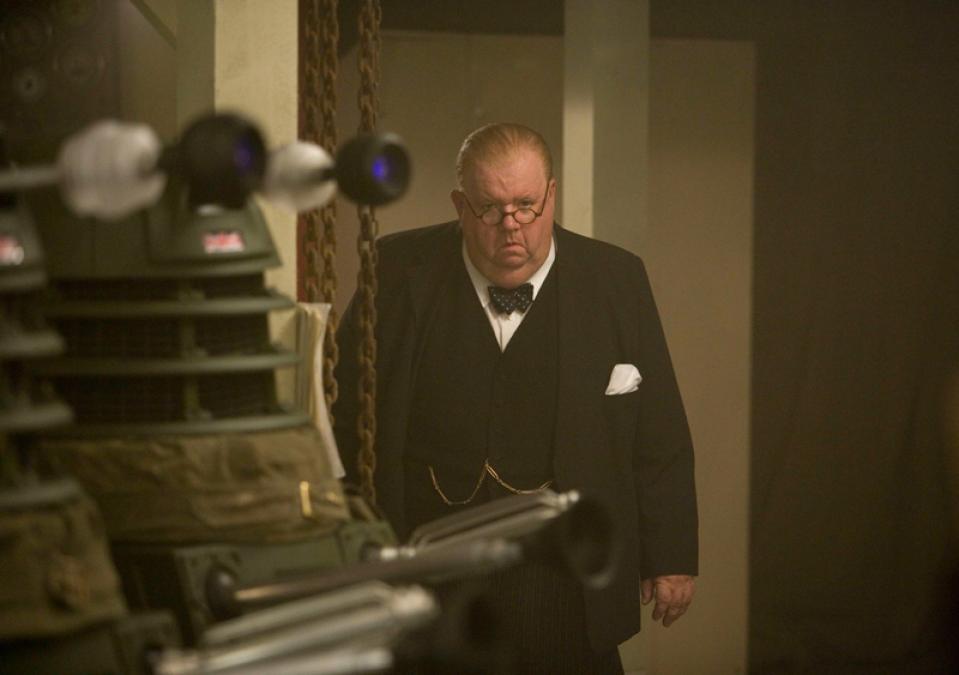
  • The characters this episode are decent enough. Winston Churchill is a caricature spouting out famous quotes when prodded but Ian McNeice plays the part well, and his friendship with the Doctor is great fun to watch, especially when he tries to steal a TARDIS key. Bracewell is hardly the most memorable of characters but has two of the best scenes in the episode - his bomb being defused by his belief that he is human and the final scene where he's delighted to go on living and packs his suitcase to go off and live.
The Valeyard's Case:
  • A bad quotation: "I love me a squaddie." "I am the Doctor, and you are the Daleks!" "Don't mess with me, sweetheart." "Do your worst, Adolf!"
  • The teaser wasn't necessary. We didn't learn anything from it that we couldn't have from the moment of the Doctor and Amy's arrival to the reveal of the Ironsides. If it was just so that that woman could mention her boyfriend in an attempt at world-building and adding an element of emotion, it failed on both accounts. Getting a regular person's perspective on the war and why they might be so blindly willing to trust the Daleks to end it would have been a great addition to the episode. Alas, that wasn't to be.
  • Amy is far too casual in her treatment of both the Daleks and Winston Churchill. Rose was tentative around Metaltron in Dalek and was in awe when she met Queen Victoria; Martha exclaims "what the hell is that?" when she first sees a Dalek in Daleks in Manhattan and is amazed to meet Shakespeare. Just like her successor Clara Oswald, Amy takes things in her stride far too easily. How can the audience be nervous about the Daleks if the companion isn't? How can we care about meeting Winston Churchill if Amy doesn't? 
  • "Have you ever fancied someone you know you shouldn't? Hurts, doesn't it?" Amy fancies the Doctor already? After Grace, Rose, Reinette, Martha, Astrid, Christina and River (and Clara yet to come), it would be more interesting if there was a female who didn't fancy the Doctor. She's supposed to be getting married in the morning and a companion with so few scruples is difficult to like. 
  • I'm one of the few without a strong opinion on the new Dalek designs. They're quite cartoonish, yes, but the speed at which the design is dropped is ridiculous. Moffat could have tried to make them work but chooses to cowardly write them out as much as possible, with them pretty much disappearing after series 5. The new Daleks are introduced, do nothing but stand around in that one room and then retreat. They should have been fearsome and shot up the war chambers or something rather than being entirely impotent on that ship. Because of all of this it's difficult to see Victory of the Daleks as much more than a failure at Dalek marketing. A story that was quickly hushed up and forgotten about.
The Inquisitor's Judgement: As far as Dalek stories go, this is certainly one of the worst. Steven Moffat said in a 2018 interview on the Fan Show that he hadn't given enough attention to the second production block, and it shows. Although Bracewell and Churchill are good guest characters, the plot of this episode is paper-thin and the Daleks are something of a non-threat outside of the small vignettes of them looking suspicious in hallways early on. F


Doctor Who (Series 5)
The Beast Below  Victory of the Daleks  The Time of Angels/Flesh and Stone

Monday, 15 January 2018

The Beast Below review [Steven Moffat]

"In bed above we're deep asleep, while greater love lies further deep. This dream must end, this world must know. We all depend on the beast below." - Amy Pond
The Eleventh Doctor finally takes Amy into outer space after all her years of waiting. Starship UK flies past the TARDIS and the Doctor decides to land, unaware of the conspiracies, torture and murder occurring below.
The Doctor's Case:
  • The episode begins with an amazing pre-credits sequence. The opening shot of Starship UK is breath-takingly atmospheric, and seeing the Union Flag and the buildings saying "Surrey" and the like is intriguing. London's forty decks below? Children are given scores at the end of the school day that determine what they can do? A child is dropped from a lift to the beast below? It immediately stirs interest in the world we're soon to be dropped into.
  • The Doctor claiming that he doesn't involve himself in the affairs of other worlds is funny enough on its own, but him popping up on the scanner and beckoning Amy to him is very amusing. He cleverly works out that there are no engines and his analysis of the crying girl is, whilst something one could easily imagine the Tenth Doctor doing, a good example of the Doctor's detective skills.
  • A spaceship that couldn't possibly fly is in flight. Voting booths that impart information and allow you to protest or forget. Moffat quickly sets up an interesting mystery.
The Valeyard's Case:
  • This is our first adventure out in space with the Eleventh Doctor and yet in the climax we see him being unpleasant to Amy, shouting at her and telling her that he'll be taking her home, and saying that very soon he'll have to find a new name for himself. Whilst nowhere near as bad as The Twin Dilemma, it's not a great idea to be showing the new Doctor in this sort of light this early on. The Doctor should be the one to save the day.
  • Amy being held out of the TARDIS isn't quite as magical as it should be. When Donna opened the doors and gazed out in The Christmas Invasion, it was wondrous. Perhaps because we've seen it before or because it could have been shot better, Amy's reaction leaves a lot to be desired. 
  • In fact, Amy takes it all in her stride far too easily. She arrives on an alien world and in the space of a few seconds she frantically remarks how far into the future she is and how she's been dead for centuries, then she's over it. We got some lovely scenes between the Ninth Doctor and Rose about these subjects in The End of the World and whilst recycling them would be dull they could be refreshed and given a new perspective. Karen Gillan's rapid-fire delivery doesn't help very much, making these sentiments just words rather than her character's worries. She finds out she's in a police state and the Doctor leaves her alone and she's absolutely fine.
  • Liz Ten is somewhat flat most of the time, failing to convince as a queen distrusting her own government. When waving her guns about she reminds one of River Song. Or, rather, the psychopath River Song that the genial archaeologist from Silence in the Library will become this series.
  • The Doctor makes a creature audible and is then asked to stop it. This was done better and with far more emotion in Planet of the Ood. Also, will the star whale really want to continue flying Starship UK after two centuries of unending torture?
His Constant Companion: Protesters are dropped from the voting booths into the star whale's mouth, where they're eaten.

I'll Explain Later:
  • How is Liz Ten unaware that she's so old? Have the population not told her that her reign's lasted two centuries? It seems very strange that she would have no idea about this.
  • If Scotland left, why is the Union Flag still whole? Surely St Andrew's cross should have gone with the Scots.
The Inquisitor's Judgement: Despite a very promising teaser, The Beast Below doesn't quite deliver what it promises. C


Doctor Who (Series 5)
The Eleventh Hour  |  The Beast Below  |  Victory of the Daleks

Tuesday, 19 December 2017

The Eleventh Hour review [Steven Moffat]

"Basically, run." - The Doctor
After his most violent regeneration yet, the Doctor lands in the back garden of a Scottish girl with a crack in the fabric of reality in her bedroom wall.

Matt Smith is the Doctor.
The Doctor's Case:
  • Christopher Eccleston is awkward at times in Rose when asked to be quirky. David Tennant fails to give the Tenth Doctor a real identity until almost halfway into series 2. Almost every leading man has needed at least their first story to come to grips with who their Doctor is and how they're going to play it. Peter Davison admitted he had no idea what he was doing and just walked around smiling in Four to Doomsday. Wisely, The Eleventh Hour was held off until The Beast Below through The Time of Angels/Flesh and Stone had been filmed, meaning that Matt Smith is marvellous from the off, slipping into the shoes of the Doctor so easily that it's easy to forget that those Converse had another man in them just an episode ago. Matt Smith isn't one of my favourite Doctors but his performance in this story is sterling and quite possibly his best in the role, later becoming almost caricatured by the time of his departure. We'll discuss that later.
  • The up-and-down regenerative trauma set the Sixth Doctor off on the wrong foot as a schizophrenic coward in The Twin Dilemma, made the Seventh Doctor look ridiculous in Time and the Rani and made it difficult to get a feel for Twelfth in Deep Breath. Moffat chooses to largely forego the Eleventh Doctor's regeneration sickness after the food sequence. This was a clever choice, letting us get a feel for who this new Doctor is, which was an issue with having the Tenth Doctor bed-bound for most of The Christmas Invasion
  • The Doctor meeting a girl only to come back to find her a woman happened in The Girl in the Fireplace but it's explored more here with Amy Pond, the first primary companion to hail from somewhere other than London since Grace Holloway. This is a refreshing change as London had become far too prevalent in the show. Unfortunately we'll be returning there when Amy and Rory move and then again with Clara in The Bells of St John. Let's enjoy the small-town vibe of Leadworth while we can, the only place in the UK that isn't London or Cardiff.
The Valeyard's Case:
  • Opening with the zoom-in on Earth again? It had a purpose in Rose, but it doesn't here. It's much too quick and, by this point, unimpressive.
  • Amy pretends to be an English policewoman for no other reason than to throw off the audience.
  • The CGI of Prisoner Zero isn't very good at all, particularly in the scene where it hides over Amy's shoulder. How does it get around, anyway? It seems to be permanently attached to the ceiling when not in human form.
  • The "what did I see?" sequence is unnecessary and ridiculous and eats up both money and time.
  • It wouldn't have taken a moment for Rory to show the pictures of the coma patients to Dr Ramsden. Why not do it before his dismissal? Any reasonable person would have.

A Good Quotation: "So, all of time and space, everything that's ever happened or ever will. Where do you want to start?" (The Doctor)

When Are We?: The majority of the episode takes place in 2008, with the Doctor meeting Amelia Pond in 1996 and Amy joining him in 2010. This episode takes place almost immediately after The End of Time and just before The Beast Below.

This Reminds Me...:
  • The Doctor previously stole clothes from a hospital after regenerating in Spearhead from Space and The Movie.
His Constant Companion: Dr Ramsden and the nurses are presumed to have been killed by Prisoner Zero.

I'll Explain Later:
  • Amy doesn't have a car and she lives in a tiny village where everyone knows one another. How does she have a career as a kissogram?
  • Why did the coma patients all say "Doctor"?
The Inquisitor's Judgement: It's rare for a new Doctor to get a great first story but this one is really very good. It's a little thin on plot but getting to see the new Doctor in action rather than suffering regeneration sickness, being unlikeable or being bedbound. Young Amelia Pond is a good character and the older Amy is good too, perhaps at her best here (having a bit more to her than sexuality and sarcasm), and her fairytale relationship with the Doctor is well-done. The Eleventh Doctor had the potential to be one of my favourite Doctors after I first watched this episode and, whilst that didn't come to be the case, it's still a fantastic performance in a decent story. I'd rank this episode at an A.

Doctor Who (Series 5)
The End of Time  |  The Eleventh Hour  The Beast Below

Popular posts