Showing posts with label Daleks. Show all posts

Tuesday, 4 September 2018

In Remembrance review [Guy Adams]

When an alarm is triggered at Coal Hill Academy, Quill and Charlie encounter a mysterious intruder prowling around school premises. Worse, they also encounter a Dalek. Their only hope of survival lies with the stranger: a woman who calls herself 'Ace'...

When: 2016 and 1963.

The Doctor's Case:
  • The best moment of this story would have to be when Quill talks about how she used to think of herself as a hero, but that now she's nothing in a world full of people she hates.
The Valeyard's Case:
  • A Bad Quotation:
    • "How's that for technology, you arrogant, stupid, tinned racist!?"
  • The best thing about School Reunion isn't that Sarah Jane Smith came back but that she'd changed and grown since leaving the Doctor. She's built a new life and isn't the young companion that she once was. Unfortunately, Dorothy McShane isn't any different to the younger Ace we've had in so many audio dramas - she doesn't sound any different than in, say, Earth Aid. It's a shame because I was looking forward to getting to see something new from Ace, but whilst School Reunion left you wanting more of Sarah and even spawned The Sarah Jane Adventures, In Remembrance does nothing for Ace.
  • Most of the story is set in 2016 with Dorothy and Quill talking and interacting with the Dalek, sidelining the arguably more interesting story of Charlie being stuck in a battleground in 1963. It's something we barely see and given how time travel isn't a theme of Class, I would have thought they'd have made the most of it.
Honours Roll: Daleks get blown up in 1963.

I'll Explain Later:
  • How come Quill knows so much about the Daleks whilst Charlie doesn't?
This Reminds Me...:
  • The events of Remembrance of the Daleks are an important part of this story.
  • Charlie suggests running up stairs to escape the Dalek. Rose tried this in Dalek.
  • A Charitable Earth was mentioned in Death of the Doctor.
  • Ace mentions the Bandrils from Timelash and Fenric from The Curse of Fenric.
The Inquisitor's Judgement: Considering this was the one I was looking forward to the most, I was left disappointed, especially by Dorothy who doesn't seem to have changed or grown much at all since being returned to Earth by Braxiatel. Quill was good, as usual, and Charlie's scenes in 1963 were far too short and infrequent. However, this was still an okay story and deserves a C.


Everybody Loves Reagan  Now You Know...  In Remembrance

Sunday, 17 June 2018

The Pandorica Opens/The Big Bang review [Steven Moffat]

A Steven Moffat two-parter. We've had The Empty Child/The Doctor DancesSilence in the Library/Forest of the Dead and The Time of Angels/Flesh and Stone, which count amongst the very best of modern Doctor Who. How will this one compare?

The Doctor's Case:
  • A Good Quotation:
    • "You graffitied the oldest cliff-face in the universe." / "You wouldn't answer your phone."
    • "What's it short for? Roranicus?"
    • "Hi, honey. I'm home." / "And what sort of time do you call this?"
    • "I'm River Song. Check your records again."
    • "Where's the Dalek?" / "It died."
    • "Not to you?" / "He doesn't really know me yet. Now he never will."
  • We've seen the Eleventh Doctor foster a friendship with a little Scottish girl. We've seen him come to the rescue of Dr River Song and begin peace talks with Silurians and move in with Craig Owens. Now we get to see him take on something grander and potentially universe-ending and Matt Smith does a very good job as usual. He seemed to struggle a little early in the series, but by this point he's definitely the Doctor. The speech at Stonehenge is wonderfully delivered (even if I can't help but wonder why he's not shot to smithereens - they won't shoot him but will lock him up and leave him unguarded?).
  • Dr Song isn't as interesting as she was in her previous appearances, but this episode doesn't focus very much on her so this is understandable. After showing the painting to the Doctor, she's just one of his companions who happens to be able to fly the TARDIS (somewhat like Nyssa in that regard), which isn't necessarily a bad thing - we don't need to spend every one of her appearances wondering who she is. There's no hint of the smugness that would come to overtake her character and which was visible to a much smaller degree in her first two stories. Her escape from the Stormcage is a good scene and the stick-figure being held at gunpoint is funny.
  • Seeking to contend with the extraordinary opening of The Time of Angels, we get a teaser that sprawls space and time. It's nice to see people from across this series (Liz Ten, Churchill and that robot scientist guy, Vincent, River) and have all these disparate worlds and stories connect in a way. It doesn't feel like it but it's seven minutes long, teasing you with what the painting is.
  • It's not quite as effective as Sarah crying over the imminent death of her adoptive son in The Stolen Earth, but the reactions of the Doctor, River and Amy to the threat of the Daleks gives the thought of them makes them seem so scary that you almost forget their neutering only earlier this series in Victory of the Daleks. The presence of the Daleks should never garner a reaction any less terrified than River's.
  • Amy shows fear and sorrow and amiability and you might almost forget the smug and unknowable cheat that we travelled with for most of this series. Rory is back, as a Roman, and the scenes between the couple, as Rory struggles to make Amy remember him and then Amy tries to stop him from going Auton, are probably the best scenes of the two of them together. Unless seconded by Amy's Choice. Rory shooting her is tragic. The Big Bang is her best episode since Amy's Choice. She really was very good in this one, as a companion and in the scene where she remembers the Doctor at her reception.
  • River in an exploding TARDIS; Amy's been shot; Rory's an Auton; the Doctor's been sealed in the Pandorica by the unholiest of alliances. What a way to end an episode. This is surely one of the best Doctor Who cliff-hangers.
The Valeyard's Case:
  • A Bad Quotation:
    • "I hate good wizards in fairy-tales. They always turn out to be him."
    • "She is to me!"
    • "You absolutely definitely may kiss the bride."
    • "We haven't even had a snog in the shrubbery yet."
  • As can be seen in the first of the bad quotations, Moffat indulges in a little mythologising of the Doctor. It's something Russell T. Davies was very guilty of himself and it's always a bad thing. Can't he just be a madman with a box?
  • The Doctor calls in the Romans to fight the Alliance. Putting those lives in danger, risking damage to the timeline with their deaths, is a strange choice for the Doctor to make, not to mention their lack of effectiveness against a million starships.
  • The Cyberman beneath Stonehenge serves a purpose but doesn't make for a particularly gripping scene. Perhaps I've just been disillusioned with the Cybermen.
  • Did anyone else guess that the Pandorica was the Doctor's prison? When he said about the prisoner dropping from the sky and messing up your world it seemed obvious.
  • Up until the final five minutes, this was a great showing for Amy, then she goes and delivers the last two quotations above. Thanks for reminding us of the terrible life choices of Amy Pond on the night before her wedding. I was in danger of liking her.
  • The Big Bang, whilst not hugely difficult to understand, is needlessly over-complicated with Moffat's trademark timey-wimeyness.
  • The "1,894 years later" wasn't at all necessary. The viewers are surely clever enough to work this out the moment we hear little Amelia's voice.
  • We met Jackie Tyler in Rose's first episode; Francine and the other Joneses in Martha's first episode; and Sylvia and Geoffrey Noble in Donna's. It's taken this long to finally meet Amy's aunt Sharon. Amy's lack of a family has retroactively become a plot point - there was no hint of anything being wrong with Amy's family life until the Doctor mentioned the size of the house in the previous episode - but the lack of a family to teach us more about her as a person has made her more difficult to warm to than her predecessors.
  • What luck that Amelia touched the Pandorica! Exactly what was the Doctor going to do if she hadn't? Lured her there a second time?
  • There couldn't have been a less satisfying way to deal with the Doctor's predicament at the end of The Pandorica Opens. After all the drama, the Doctor is released with the flick of a screwdriver given to Rory by... his freed future-self. No. It makes no sense.
Professor Who?: River can fly the TARDIS and was taught how to by the Doctor. She has met the Daleks before. She once dated an Auton who could swap heads. This was presumably before her imprisonment. She's scary enough that a Dalek asked for mercy after checking its records on her. She's married, and the Doctor will very soon find out who she is.

The Pandorica is Opening: The Pandorica was created by the Alliance from a snapshot of Amy's memories. It's a prison based on Pandora's box, built to contain the Doctor so that he can't fly the TARDIS, meaning that it will never blow up and cause the cracks in time. However, the Alliance was apparently unaware that Dr Song can fly the TARDIS as well and it's actually her who's flying it when it explodes.

The Universe is Cracked, Silence will Fall: The TARDIS was remotely controlled and blown up with River inside it in an attempted assassination of the Doctor, as it was assumed that he would be flying it. The Silence is still out there. The Doctor wonders why they drew the TARDIS to the date of the Williams-Pond wedding and why they blew it up.

I'll Explain Later:
  • The Doctor knew about this cliff-face but is only now going to look at it? Coincidentally whilst he's travelling with the mother of the woman who wrote the message? Whilst in this incarnation? After he's met Vincent? Seems awfully lucky.
  • How did the Alliance form? Daleks were willing to team up with Terileptils and Sontarans and Slitheen? The Cybermen were willing to team up with Draconians and Drahviins and Zygons? It shows how dangerous the threat of the TARDIS exploding is to all of existence, but it seems something that even Mance Rayder might struggle with organising.
  • River's met the Daleks before? Why haven't Big Finish shown us her first encounter with them yet? Get on it.
  • When River begs the Doctor to run, he asks where he could run to. Doesn't she have a vortex manipulator that could take them anywhere and anywhen?
  • River identifies some ships as Slitheen. Shouldn't she have said Raxacoricofallapatorian?
  • Rory is a Roman because he was taken from a snapshot of Amy's memories on the day of her wedding, but Rory ceased to exist and Amy doesn't remember him so how is this possible and how is there a photograph of him at Amy's?
  • Don't the Cybermen chop people up before dumping their brains in a metal suit? How come there's a whole skull inside the Cyberman's head? Was Yvonne Hartman still blonde and beautiful when she took down her cyber-comrades for Queen and country?
  • How did the Alliance know that the TARDIS was what caused the cracks in time?
  • How did River know to give Amy her diary? She must have forgotten the Doctor as everyone else had. How can she even exist given that the Doctor's existence was the reason that she was born? How does her diary exist? The timey-wimeyness doesn't make much sense.
  • If the universe has been restored, does that mean Amy and Rory remember the Daleks now? If so, why doesn't Bill Potts?
The Inquisitor's Judgement: The Pandorica Opens has a fantastic opening sequence and a very good ending and is undoubtedly the better episode of the two. Between these two points is a decent-enough episode, even if it isn't thrill-a-minute. There's certainly some empty space that could have used filling in order to make this a great episode. In The Big Bang, some questions are answered, some questions aren't. All in all, this second half wasn't great, being unnecessarily complicated by vortex manipulators and cracks in time and rules that don't make the least bit of sense. Amy, River and Rory were all decent, as was the Doctor, but this episode was just a bit too messy when its actual story could have been so much more streamlined. In conclusion, this two-parter altogether deserves a D.


Doctor Who (Series 5)
The Lodger  |  The Pandorica Opens/The Big Bang  A Christmas Carol

You Might Also Like...

Wednesday, 13 June 2018

Asylum of the Daleks review [Steven Moffat]

What can the Daleks do when faced with a task so terrifying that they won't dare attempt it themselves? They call the Doctor.

When and Where: The Dalek Asylum at an unknown time.

The Doctor's Case:
  • A Good Quotation:
    • "You think hatred is beautiful." / "Perhaps that is why we have never been able to kill you."
  • The main villains of this story are the insane Daleks, but the far more successful foes are the latest addition to the Dalek mythos - the puppets. The idea of Daleks mutilating a dead body without respect and turning it into a mindless drone is a gruesome idea and a frightening one given that anybody could be one without even knowing it. Why an eyestalk is needed I'm not sure but it can't be denied that it's a scary image, far more than the Robomen of The Dalek Invasion of Earth.
  • Oswin Oswald proves to be an exceptionally good character that, even if Jenna Coleman didn't return, would prove memorable. She's a technological marvel and a certified genius who boarded the Alaska as junior entertainment manager so that she could see the wonders of the universe, asking the Doctor at the end to take her to see the stars. A shame, then, that she's a Dalek. In a shocking twist that I didn't see coming, Oswin was a Dalek the whole time. It makes for a tragic turn for the confident and cheery character and makes for the best sequence of the story where Oswin realises that she's no longer human. The episode's gain is the show's loss because Oswin is far more interesting and engaging than the vacuum that will fill the role of companion by the name of Clara Oswald. Had Oswin joined, we could have had a relationship similar to Second and Zoe or Fourth and Romana - two geniuses travelling the universe and butting heads. There's nothing more for the show to say about Amy and Rory, but a wealth to be gained from an adventure-deprived genius entertainment manager from the future.
  • The Daleks haven't been scary since... probably Bad Wolf/The Parting of the Ways, with the reason being that nobody acts as though they're frightening. The biggest offender by this point is Victory of the Daleks, in which neither the Doctor nor Amy fear them. They don't even seem to take them seriously. In this story, we get to see the Doctor scared of them again, yelling with his back to a locked door as Dalek suckers approach him.
The Valeyard's Case:
  • A Bad Quotation:
    • "Don't be fair to the Daleks when they're firing me at a planet."
    • "Doctor... who? Doctor... who? Doctor... who?"
  • The Doctor is told by the Dalek puppet at the beginning that her daughter is in a Dalek camp and that she arranged her meeting with the Doctor because the best way of getting him to help was to intrigue him. Firstly, the Doctor shows absolutely no signs of caring about her daughter or expressing any disgust at the Dalek camps like any of his predecessors would. Secondly, the Doctor shouldn't have to be intrigued in order to help someone. Sherlock Holmes, yes, but not the Doctor.
  • The Parliament of the Daleks isn't just stupid. It's unnecessary, which is the worst kind of stupid. Daleks aren't a parliamentary race and nor would they elect a Prime Minister given that they don't have any individual identities. The story could have been about the Doctor, Amy and Rory landing on the asylum and trying to get back to the TARDIS - cutting out the Parliament doesn't change the plot in any way at all. The Prime Minister being a thoroughly unconvincing rubber prop doesn't help, especially not when Metaltron from series 1 looked so much better.
  • Series 5 was about Amy's cold feet before realising that she truly did want to marry Rory, who always doted on her. Series 6 has the married couple have a child that they look for and learn that they raised all along thanks to time travel. Now Amy and Rory are a signature away from divorce and the break-up happened off-screen between seasons? It doesn't make any sense and, even worse, it has absolutely no lasting effects. The two would have had a good exit being left with a new house in The God Complex by the Doctor to keep them safe, or after learning from River that the Doctor is alive in The Wedding of River Song. Perhaps even after sharing Christmas dinner with the Doctor in The Doctor, the Widow and the Wardrobe. The pair are outstaying their welcome at this point with absolutely nowhere new to go with these characters. Oh, and their marriage troubles which led them to divorce are resolved with one short conversation mid-episode.
I'll Explain Later:
  • How is Skaro back? The Doctor destroyed it in Remembrance of the Daleks.
  • The episode is called Asylum of the Daleks, but what separates the committed Daleks from the usual ones? They don't seem any more insane than those on the spaceship.
  • The only way to disable the shields of the asylum planet is actually in the asylum? How daft is that?
This Reminds Me...:
  • The intensive care Daleks come from Spiridon (Planet of the Daleks), Kembel (The Daleks' Master Plan), Aridius (The Chase), Vulcan (The Power of the Daleks) and Exxilon (Death to the Daleks).
  • The Daleks turned humans into Daleks in Revelation of the Daleks and Bad Wolf/The Parting of the Ways.
The Inquisitor's Judgement: Asylum of the Daleks has faults. If Amy and Rory are going to have marital troubles, we should see them happen, not be reintroduced to them signing the divorce papers and then making up half an hour later. However, this episode is probably the best since The Impossible Astronaut/Day of the Moon and was actually far better than I remember it being. Dalek Parliaments aside, the Daleks are for the most part scary once again and we have an engaging guest character who turns out to be a Dalek. Throw in some decomposed bodies with Dalek eyestalks and what more could you want from a Dalek story? A little daft in places, yes, but this episode is very good and earns itself an A.

Doctor Who (Series 7)
The Doctor, the Widow and the Wardrobe  |  Asylum of the Daleks  Dinosaurs on a Spaceship

Saturday, 12 May 2018

The Heart of the Battle review [Nicholas Briggs]

The Daleks want peace with Gallifrey. Ollistra sent Seratrix to them to broker a peace, but why send the Doctor and a team of Time Lords after him?

When and Where: Keska, between The Thousand Worlds and Legion of the Lost.

The Warrior's Case:
  • A Good Quotation:
    • "Where can I find you, Doctor, when I need you again?" / "At the heart of the battle, where the blood of the innocents flows and only the monstrous survive."
  • Trying to make peace with the Daleks sounds ridiculous, but Seratrix's belief that this could be a reality makes more sense when we learn that they've been given an empire of more than a thousand planets.
  • We've been told that Ollistra is a master manipulatrix but it's not until this story that we see any evidence of this. She sent the peace-desiring Seratrix to the Daleks to die and tried to dispose of his fellow believers Bennus and Arverton by "randomly" selecting them to detonate the Time Destructor. When the Doctor saved them, she planned to get rid of all three by sending them after Seratrix, willing to sacrifice Veklin in the process.
The Cardinal's Case:
  • We learn that the purpose of the Daleks' plan (the same as in The Dalek Invasion of Earth) is to fire planets at Gallifrey (the same as in The Apocalypse Element), resulting in a story that lacks in originality. Also, a thousand planets being fired at Gallifrey at 50x the speed of light is ludicrously over the top.
This Reminds Me...:
  • The Daleks' plan is a combination of their plots in The Dalek Invasion of Earth and The Apocalypse Element.
The Inquisitor's Judgement: After a disappointing start, The Heart of the Battle ends the box set on a better note than it started. All plot threads introduced through this lacklustre box set are wrapped up and the Doctor and Ollistra are reset and ready for the next volume, with Rejoice gone. She was much better as an older woman than a young girl, but was still one of the most forgettable and bland Big Finish companions. Concluding a poor first series of The War Doctor, this is an okay story, and that earns it a C.

The Thousand Worlds  |  The Heart of the Battle  Legion of the Lost (Infernal Devices)

Monday, 7 May 2018

The Thousand Worlds review [Nicholas Briggs]

The Doctor is sent behind enemy lines to find a Time Lord strategist who holds vital Gallifreyan secrets. The Daleks are playing with drills again. When will they learn that this never ends well for them?

When and Where: This is set on Keska, between The Innocent and The Heart of the Battle. For Rejoice, it's been decades.

The Warrior's Case:
  • Rejoice was a pleasant character in the previous story, even if her feelings for the Doctor were a little strange. Her reunion with the Doctor here is a highlight, with Hurt's delivery of the line "Hello... Rejoice" being heartwarming. 
  • Beth Chalmers has a wonderful voice and does a good job as Veklin. It's a shame that it's difficult to separate her from Raine Creevy given how she uses the same voice and accent.
The Cardinal's Case:
  • In the beginning of The Innocent, we had a Time Destructor used. Here, we don't have a weapon return but an entire evil plan - the drill one from The Dalek Invasion of Earth. Nods or returning weapons are welcome but the Daleks having the exact same plot means that this story isn't that original. It's The Dalek Invasion of Earth with more Time Lords and fewer twisted ankles. The titular Thousand Planets are reminiscent of The Stolen Earth/Journey's End, as well.
  • What was the point in The Innocent? This story could just have easily have been the first of the box set, functioning perfectly as an introductory story and would arguably have been a better one. To be reintroduced to the War Doctor on a Gallifreyan machine behind enemy lines is far more unique a beginning than him having a traditional adventure.
I'll Explain Later:
  • "Keep to the cloisters," Veklin says. Hopefully these aren't the same super deadly, seriously dangerous cloisters we see in Hell Bent.
This Reminds Me...:
  • The Doctor has met his companions when they're older before, with Molly O'Sullivan for example.
  • The Daleks' drilling plan was previously enacted in The Dalek Invasion of Earth and Lucie Miller/To the Death.
The Inquisitor's Judgement: Slightly better than the previous story, The Thousand Worlds is nothing too special. It's The Dalek Invasion of Earth with sprinklings of The Stolen Earth and The Traitor. The Daleks supposedly wanting peace is an interesting enough twist, but I'll eat my hat if they aren't lying. This story is bad, earning it a D.

The Innocent  |  The Thousand Worlds  The Heart of the Battle

Sunday, 6 May 2018

The Innocent review [Nicholas Briggs]

The Doctor is dead, killed by the Time Destructor that wiped out the largest Dalek time fleet ever assembled. Except, of course he's not. He's alive and well (enough) and living on Keska.

When and where: The planet Keska. The War Doctor is old and tired, so this is later in his life. The whole War Doctor series is set some time between The Night of the Doctor and The Day of the Doctor. For Ollistra, this is after The Eighth Doctor: The Time War.

The Warrior's Case:
  • A Good Quotation:
    • "I KNOW THE DALEKS! I know them!"
  • We're introduced to Cardinal Ollistra of the High Council, who's not given much to do but makes an impression regardless. She's a Time Lady who hates the Daleks, but there's more to it than that. She seems to think that she has a special relationship with the Daleks, believing that she knows and understands them better than most and utterly despises them. It's the same feeling that the Daleks feel for all other life-forms. To have a Time Lady hate the Daleks so personally makes Cass's question of who can tell the difference between the two races anymore that much more poignant. Ollistra would be a good Dalek.
  • The Time Destructor, which so tragically killed Sara Kingdom in The Daleks' Master Plan, is a terrifying weapon and it was a great idea to bring it back for the Daleks to use in the Time War. I always like it when Big Finish use little bits of continuity in this way.
  • Rejoice isn't a particularly memorable character but that name... It's a beautiful one.
The Cardinal's Case:

  • The cold open introduces Ollistra and tells us about the destruction of the Dalek time fleet, but it seems strange for the teaser for the first audio of the first War Doctor box set to be that the Doctor is dead. Firstly, he obviously isn't. Secondly, we haven't had the opportunity to get to properly relate to or learn about the War Doctor aside from his last day before regeneration in The Day of the Doctor. It's a shocking moment for Ollistra, but not for the listener who hasn't yet heard a word from the character. If Ravenous 1 were to begin with this, it would work. We know the Eighth Doctor and we'd wonder what happened to him, what happened to Liv and if she's alive, and how did the Doctor get out of it. Here, it isn't a successful opener.
  • This story is pretty much traditional Who with a little more character work with the Doctor. To use a story so rote and quiet to kick off the War Doctor series wasn't the best move. This is the Doctor who wasn't the Doctor, but he acts just as the First, Sixth or Twelfth Doctors do. He's not a blood-soaked warrior like we were promised. Surely we should have seen some of that first so that his opportunity to rest on Keska would be more interesting and more tempting to him.
  • Rejoice having something of an attachment to the Doctor after nursing him for months makes sense, but it's taken a little too far. Perhaps it's her Keskan optimism but she's far too kind to and forgiving of the Doctor, most notably after the boat debacle.
  • I never like it when they use the same photo of a character twice on one cover.
This Reminds Me...:
  • Rejoice looks after the Doctor just like Rose did in The Christmas Invasion.
  • I misheard "Arverton" as "Arbitan" (of The Keys of Marinus) and was wondering if Big Finish were really going to bring such an obscure character back for the Time War.
  • Veklin is voiced by Beth Chalmers, AKA Raine Creevy, who first appeared in Crime of the Century.
The Inquisitor's Judgement: The Doctor lands on a planet, saves the day and leaves with a companion. Granted, the companion is sent home by Ollistra but otherwise this is a very traditional story that fails to be the explosive start to the War Doctor series that it needed to distinguish itself. John Hurt and Jacqueline Pearce are, as expected, amazing but the plot is thin and the characters not given the most interesting of material whilst wannabe-companion Rejoice - such a lovely name - fails to make an impression, just being kind of nice. This is a bad story, and that earns it a D.


The Innocent  |  The Thousand Worlds

Tuesday, 10 April 2018

Blood of the Daleks review [Steve Lyons]

An asteroid hit Red Rocket Rising, causing mass destruction and panic across the humans living there. The politicians are blamed, but never fear. A kindly race offer charity. They too have suffered struggles during their time, and they are here to help. They're called the Daleks.

Where and When?: This story takes place on Red Rocket Rising. For the Doctor, this is after Running Out of Time and before Horror of Glam Rock.

The Doctor's Case:
  • A Good Quotation:
    • "People of Red Rocket Rising, my fellow citizens. Our long night is over. I've been contacted by a benevolent people. They too have known great trials, but they have overcome them and made it their mission to help others do the same. They have offered us refuge, and passage to the nearest human worlds. They have the resources, and the patience and compassion, to evacuate every one of us. My fellow citizens, my friends, rescue is at hand!"
    • "Yeah, bye, bored now."
  • By the time Christopher Eccleston graced our screens as the Ninth Doctor, the Eighth Doctor's main range stories were deep into its Charley arc. The BBC wanted to have Doctor Who on the radio for the new audience of people introduced by the new TV series, leading Big Finish to cut the Divergent Universe arc short and begin the Eighth Doctor Adventures with a clean slate. The Doctor is travelling alone, Lucie is introduced and there are no references to his previous companions or Big Finish adventures, deliberately making Blood of the Daleks a great starting point for new listeners.
  • Just as Donna Noble later would, Lucie Miller appears in the TARDIS console room without explanation. Why, in 2006, did both the show and Big Finish introduce companions this way? Because it's a great idea. The Doctor travels time and space, dropping in and out of people's lives and sometimes taking people away with him as his travelling companion, and it's about time that someone was dropped in on him. The original idea was to have a Time Lord appear to explain the situation to the Doctor but fortunately this snooze of a scene was jettisoned for a more explosive entrance and to inject a bit of mystery. Rather than introducing another Charley, Big Finish does an anti-Storm Warning. Whereas the Doctor and Charley were magnetic, the Doctor and Lucie don't very much like one another, although this isn't unbearable like the Sixth Doctor and Peri. 
  • It might be considered somewhat uncharacteristic of the Eighth Doctor to act how he does towards her, but one should remember that this takes place not long after C'rizz's death and Charley's departure. He's a moodier man than he was with Charley and is certainly a different man from the carefree man we were reintroduced to in Storm Warning. It's an interesting choice for Big Finish to make - they seem to have chosen to go in the vein of Christopher Eccleston's dark side. 
  • The politicians aren't necessarily portrayed as the nicest of people (which is nothing new), but the mob are seen to be up in arms against politicians just because it's nice to have someone to blame and politicians are always the first. The Doctor says with irony to the crowd that they should have been able to predict the crashing of the asteroid, which the crowd seem to think on for the briefest of moments before deciding to carry on with their hunt. This is an angle we don't often see given how much politicians are vilified in the real world.
  • There are some ideas which seem so obvious that you wonder why they haven't been done before. Here, we have Martez creating his (or her) own Daleks from damaged ones that she found. The scene where one of them dies with Martez assuring it that it is a superior being because of its human blood is strangely touching and sad.
  • A car being totalled after crashing into the TARDIS, which stands resolute and unscratched, is a great visual that it's a shame we have to use our imagination for.
The Valeyard's Case:
  • A Bad Quotation:
    • "This is not a date!"
  • To introduce a new companion and reintroduce the Eighth Doctor (again) to a new audience, and to then have the two bicker for the first fifteen minutes and then spend most of the story apart isn't the best idea. Storm Warning (which keeps coming up; you can tell which story I've listened to recently) doesn't have a great plot or a great villain, but it works because of the wonderful interactions between the Doctor and Charley. The Doctor and Lucie don't like each other but it would have been a better idea to have them stay together and show at least some respect develop between the two. It means that we leave the story not feeling particularly warmed to either of them. At least it's not Sixth and Peri, though.
  • The reason that Martez thinks that her Daleks are the future for humankind isn't explained. Finding a Dalek wreckage and then deciding that humans becoming this creature would be the best option for her species is something of a leap in logic.
Witness Protection: Lucie has been dropped into the TARDIS by the Time Lords as part of a witness protection program. A Mr Hulbert has hired a bounty hunter called the Headhunter to track her down and take her into her custody for reasons unknown.

His Constant Companion: The driver of the solar-powered car dies after hitting the TARDIS. Martez is killed by her own Daleks after she stops producing them, and her Daleks are exterminated by true Daleks.

I'll Explain Later:
  • The Doctor tells Lucie off for leaving the TARDIS before he had time to check the readings. Has he even done that since his first incarnation? It's certainly not been second nature to him in a few centuries.
This Reminds Me...:
  • The Doctor mentions being there at the Daleks' very beginning (Genesis of the Daleks) and fighting against them in various wars (The Daleks' Master Plan, etc.)
  • The Doctor wishes that Daleks could be good, a hope that the Twelfth Doctor has in Into the Dalek.
  • Davros made Daleks out of humans in Revelation of the Daleks and the Emperor did it in Bad Wolf, resulting in self-hating Daleks. The New Dalek Paradigm in Victory of the Daleks are similarly disgusted by the Daleks made from Davros's cells and destroy them.
  • The Doctor says that the Daleks are always in a war, asking if they have recently been fighting the Mechonoids (from The Chase), the Movellans (from Destiny of the Daleks) or each other (like in The Evil of the Daleks, Resurrection of the DaleksRevelation of the Daleks, The Juggernauts and Remembrance of the Daleks).
  • Red Rocket Rising have more help arriving, this time from Telos, the post-Mondas world of the Cybermen seen in The Tomb of the Cybermen and Attack of the Cybermen.
The Inquisitor's Judgement: Blood of the Daleks is a good start to the Eighth Doctor Adventures and a jumping on point for the Modern Who fan who prefers their stories at a snappy 50 minutes rather than the considerably longer Main Range releases. Neither Lucie nor the Doctor are at their friendliest here and the two spend quite some time apart, which is a shame and keeps us from instantly falling in love with the pair as is so easy with Ninth and Rose, Eighth and Charley or Sixth and Evelyn. Overall, however, Blood of the Daleks is a very good story, earning it an A.

Blood of the Daleks  |  Horror of Glam Rock

The Eighth Doctor's Timeline
Running Out of Time  |  Blood of the Daleks  Horror of Glam Rock

Wednesday, 17 January 2018

Victory of the Daleks review [Matt Gatiss]

"That wasn't human. That was never human technology. That sounded like..." - The Doctor
Answering a call from Winston Churchill, the Doctor and Amy land in the war chambers of 1941 England. Soon enough, Churchill unveils his secret weapon - metal pepperpots with gunsticks and eyestalks. The Ironsides.
The Doctor's Case:
  • A good quotation: "I am your ssssoldier." "I don't care if you're a machine, Bracewell. Are you a man?"
  • The easiest way to solidify a new leading man as the Doctor, the show has found, is to have him go up against the Daleks. Ninth did it in his sixth episode and Tenth did in his eleventh but Matt Smith had the difficult task of replacing the immensely popular David Tennant. Better bring the Dalek appearance forward to his third episode (and Capaldi later goes up against them in his second). The Eleventh Doctor brings a new dimension to his relationship with the Daleks - they're good, and he doesn't know what to do about that but hit one in the hopes it'll attack and be the monster he expects it to be. It's not remotely as poignant as the Ninth and Tenth Doctor's anger but it's early days. Unfortunately, this is spoilt a bit by, a) the fact that we know the Daleks are evil and we've seen this before in The Power of the Daleks, and b) they stop being good after less than fifteen minutes.
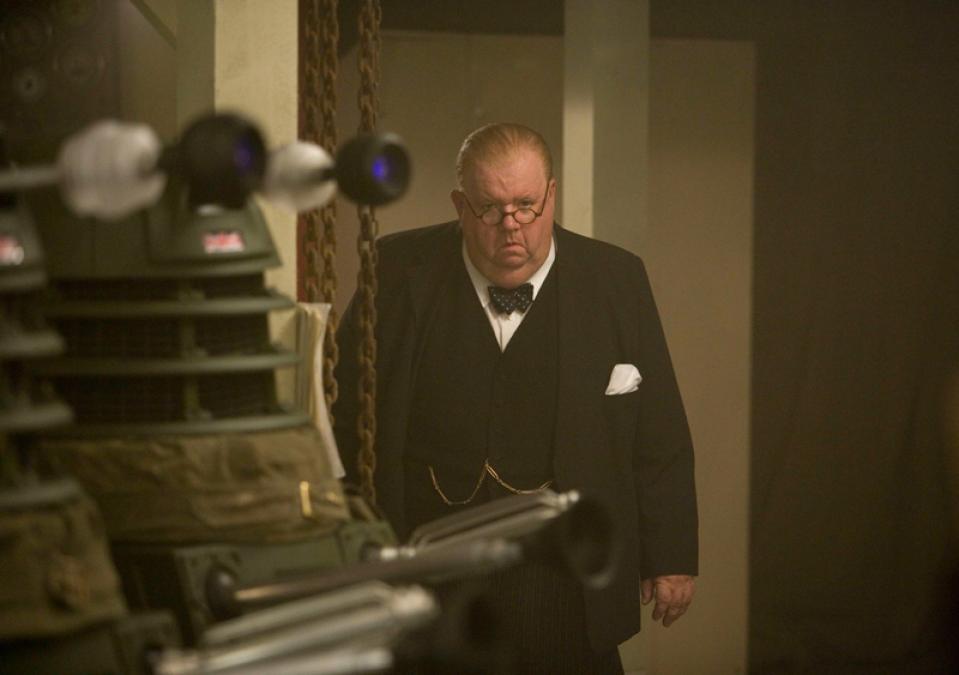
  • The characters this episode are decent enough. Winston Churchill is a caricature spouting out famous quotes when prodded but Ian McNeice plays the part well, and his friendship with the Doctor is great fun to watch, especially when he tries to steal a TARDIS key. Bracewell is hardly the most memorable of characters but has two of the best scenes in the episode - his bomb being defused by his belief that he is human and the final scene where he's delighted to go on living and packs his suitcase to go off and live.
The Valeyard's Case:
  • A bad quotation: "I love me a squaddie." "I am the Doctor, and you are the Daleks!" "Don't mess with me, sweetheart." "Do your worst, Adolf!"
  • The teaser wasn't necessary. We didn't learn anything from it that we couldn't have from the moment of the Doctor and Amy's arrival to the reveal of the Ironsides. If it was just so that that woman could mention her boyfriend in an attempt at world-building and adding an element of emotion, it failed on both accounts. Getting a regular person's perspective on the war and why they might be so blindly willing to trust the Daleks to end it would have been a great addition to the episode. Alas, that wasn't to be.
  • Amy is far too casual in her treatment of both the Daleks and Winston Churchill. Rose was tentative around Metaltron in Dalek and was in awe when she met Queen Victoria; Martha exclaims "what the hell is that?" when she first sees a Dalek in Daleks in Manhattan and is amazed to meet Shakespeare. Just like her successor Clara Oswald, Amy takes things in her stride far too easily. How can the audience be nervous about the Daleks if the companion isn't? How can we care about meeting Winston Churchill if Amy doesn't? 
  • "Have you ever fancied someone you know you shouldn't? Hurts, doesn't it?" Amy fancies the Doctor already? After Grace, Rose, Reinette, Martha, Astrid, Christina and River (and Clara yet to come), it would be more interesting if there was a female who didn't fancy the Doctor. She's supposed to be getting married in the morning and a companion with so few scruples is difficult to like. 
  • I'm one of the few without a strong opinion on the new Dalek designs. They're quite cartoonish, yes, but the speed at which the design is dropped is ridiculous. Moffat could have tried to make them work but chooses to cowardly write them out as much as possible, with them pretty much disappearing after series 5. The new Daleks are introduced, do nothing but stand around in that one room and then retreat. They should have been fearsome and shot up the war chambers or something rather than being entirely impotent on that ship. Because of all of this it's difficult to see Victory of the Daleks as much more than a failure at Dalek marketing. A story that was quickly hushed up and forgotten about.
The Inquisitor's Judgement: As far as Dalek stories go, this is certainly one of the worst. Steven Moffat said in a 2018 interview on the Fan Show that he hadn't given enough attention to the second production block, and it shows. Although Bracewell and Churchill are good guest characters, the plot of this episode is paper-thin and the Daleks are something of a non-threat outside of the small vignettes of them looking suspicious in hallways early on. F


Doctor Who (Series 5)
The Beast Below  Victory of the Daleks  The Time of Angels/Flesh and Stone

Popular posts