Showing posts with label Grade F. Show all posts

Tuesday, 9 October 2018

Sword of Orion review [Nicholas Briggs]

Sword of Orion might have been a pretty good story if it was released in the '60s. Unfortunately, by 2001 we'd seen this story a dozen times over. After the exciting freshness of Storm Warning it was important to show that Paul McGann was a modern Doctor for the modern listener, but Nicholas Briggs instead chose to remake an old fan story and show that McGann can follow the same tried-and-tested plotlines that the other Doctors have already done. It lacks ambition.

The Eighth Doctor goes up against the Cybermen in order to solidify McGann as a Doctor rather than because it was an interesting story. It's the same technique that Moffat would later do with Matt Smith (who fought the Daleks in his third episode) and Peter Capaldi (who fought the Daleks in his second episode). What do all these stories have in common? They're not that good, existing almost because the Doctor needs to go up against one of the big bads in order to be accepted.

The plot itself involves an abandoned space-station, the awakening of the Cybermen, antagonistic humans who think they can make a deal with them, blah blah blah... The guest cast are your usual Doctor Who stock characters: predictable, one-note and lacking any real colour. It's an unwelcome combination of The Tomb of the Cybermen and Earthshock. The story isn't offensively bad, but it's boring - arguably the worst thing Doctor Who can be. 

The previous story did a great job of introducing the Doctor and Charley with a script paired with convincing performances that made them both feel like breathing, warm-blooded characters. Sword of Orion does away with all of that personality and makes the pair entirely interchangeable with any other Doctor-companion duo. The dialogue and characterisation is completely generic and at a time that we should be getting to know this new Doctor, his dialogue shouldn't feel as though it could belong to any one of his predecessors. The adventure-thirsty Charley too has become more subdued and reactionary. They're hardly a pair that get you rooting for them in this story.

The Inquisitor's Judgement
Charley's first adventure in the TARDIS proves to be a disappointing affair, providing all the traditional elements of classic Who in a story that unfolds almost by rote. Storm Warning wasn't a perfect story but its characterisation was spot-on, its plot and setting new and exciting and it began the Eighth Doctor's adventures with a real sense of forwardness and invigoration. Sword of Orion, however, is by-the-numbers, tried-and-tested, been-there-done-that Who. It's an atrocious story and earns itself an F.

Storm Warning  |  Sword of Orion  The Stones of Venice

Saturday, 22 September 2018

The Mark of the Rani review [Pip and Jane Baker]

The Doctor goes to the year - umm, see below - and encounters the Master (disguised as a scarecrow for reasons), the Rani (armed with an interesting spec and some of the worst dialogue) and a cavalcade of incomprehensible Englishmen. And to top it off, he's accompanied by Peri.

When and Where: The "where" is Killingworth, England. The "when" is a little more complicated. As Thomas Liddell is Lord Ravensworth at this point, this story must take place after 17th July 1821. Humphry Davy died on 28th May, 1829 and is to be in attendance of the meeting at Killingworth, meaning that this is before 29th May 1829. The season is clearly autumn, so this story takes place in an autumn between 1821 and 1828.

In terms of subjective timelines, for the Doctor and Peri this is at some point between Vengeance on Varos and The Two Doctors. For the Master it's between Winter and The Ultimate Foe and for the Rani it's some time before Time and the Rani.

The Doctor's Case:
  • A Good Quotation:
    • "What's he up to now? It'll be something devious and over-complicated. He'd get dizzy if he tried to walk in a straight line."
    • "They're carnivores. What harm have the animals in the fields done them? The rabbits they snare, the sheep they nourish to slaughter. Do they worry about the lesser species when they sink their teeth into a lamb chop?" It's hardly groundbreaking but for a Pip and Jane script this is practically poetry.
  • What is Peri's character spec? After you've listed American, whiny and supremely unfashionable, all you have left is "botanist". Like Mel after her, who despite being a computer programmer never exercised any real skill with computers on TV, Peri almost never gets the chance to show any knowledge in her supposed field. This is one such example, where Peri gets to talk about the native plants and animals and, for a short amount of time, feels like she has had experiences outside of her tenure as a companion. It's important that companions get the opportunity to show individual skills that we've not seen from their predecessors. It makes them less interchangeable.
  • We've had the suave Master, the trickster that is the Monk and the power-hungry War Chief. The latest addition to the ever-increasing list of renegade Time Lords is the Rani. Like the Monk, she isn't evil - she's a chemist who's pursuing scientific research to quench her own professional curiosity, but without any morality or care for her test subjects. It's a far more interesting stance than the pantomime Ainley Master and makes her one of the more notable villains of the recent seasons.
  • The Rani's TARDIS is beautiful but has the side effect of making the Doctor's and the Master's TARDISes look incredibly basic as a result. Couldn't the Doctor have made off in this one at the end?
  • Horrifically unnatural dialogue isn't Pip and Jane's only forte: they're also very good at writing the Sixth Doctor, which they will do again in Terror of the Vervoids and The Ultimate Foe.
The Valeyard's Case:
  • A Bad Quotation: Pip and Janeisms:
    • "You suspect another motive?" Are we sure this is Peri? It must be some sort of switch like Amy's Flesh avatar in series 6.
    • "Spare me the dubious pragmatism."
    • "Fortuitous would be a more apposite epithet!"
    • "Murderous would be more apt." Definitely not Peri.
    • "Who's this brat?"
    • "Doctor? Do you get his drift?"
    • "Finito TARDIS. How's that for style?"
    • "All the way down. To the bottom."
    • "Grandiose schemes of ruling the universe will mean nothing if that dilettante Doctor is still at large."
    • "Now perhaps you'll accept there are more things in heaven and earth than are ever dreamed of in your barren philosophy."
    • "I'm a scientist. I've calculated the odds, and they and not idiotic pride dictate my actions." / "You intellectual microbe."
  • The dodgy accents of the English working class are often incomprehensible. It's truly terrible and makes the admittedly believable setting lose any and all credibility.
  • One of the more interesting parts of this story is Miasimia Goria, a planet over which the Rani reigns and whose people are restless and aggressive because of her experiments. What are we doing in a dull Industrial Revolution village filled with accents less convincing than Nicola Bryant's when this is going on? A sleepless and lawless planet is infinitely more interesting a setting.
  • Another plotline, albeit a retread of The King's Demons, is the Master deciding to change the course of history upon learning of the gathering in Killingworth. Unlike Miasimia Goria, this has absolutely no bearing on the story and is very quickly forgotten about.
  • Peri's dress is vile. Truly, truly vile.
  • The violence of the Luddites is wholly unconvincing, with the tapping of the chain the Doctor clings to in the pit being particularly awful.
  • Another TARDIS malfunction?
  • This story was so boring that it's taken more than a month to write this.
I'll Explain Later:
  • Kew Gardens wasn't open until 1840. Why was the Doctor trying to land there in the 1820s? And why in the autumn when the outdoor gardens would be much less impressive?
  • Why is the Master a scarecrow and what does he have against birds? In fact, what's he doing in the 1820s in the first place?
  • How does the Rani know about the events of Planet of Fire and the Master's supposed end?
  • Why does the Master refer to the Doctor's time machine as "the TARDIS"?
  • What was Peri thinking pushing the Doctor down the hill?
  • How come the Doctor's key can open the Rani's TARDIS?
His Constant Companion: The Master kills a dog and a man with his Tissue Compression Eliminator. One of the peasants falls down the well. The Master kills one of the Rani's assistants. The Rani kills three of her goons.

This Reminds Me...:
  • We visit Miasimia Goria in Planet of the Rani.
The Inquisitor's Judgement: It's been almost two months since I reviewed Vengeance on Varos. Why has it been so long? Because The Mark of the Rani was so boring and so awful that I found myself no longer enjoying writing reviews and almost stopped completely. Gosh, is it bad. The Rani is a good idea but this story is plagued with elements that go nowhere, atrocious dialogue, poor performances and a complete lack of any sparkle. I might have to rethink my position as a season 22 apologist. As a Sixth Doctor fan, this is embarrassing. This story is terrible and earns itself an F.


Doctor Who (Season 22)
Vengeance on Varos  |  The Mark of the Rani  The Two Doctors

Sunday, 24 June 2018

The Rings of Akhaten review [Neil Cross]

Clara goes on her first adventure in the TARDIS, asking to be taken "somewhere awesome". The Doctor takes her to Tiaanamat, an asteroid orbiting Akhaten where a song that's kept a god in slumber for millions of years is about to end...

When and Where: Tiaanamat, an asteroid within the Rings of Akhaten. For Clara, this is the morning after the Doctor left in The Bells of Saint John, making it still the autumn of 2013.

The Doctor's Case:
  • A Good Quotation:
    • "Did it?" / "Well, it's what they believe. It's a nice story."
    • "Quite a big thing, locally. Like Pancake Tuesday."
    • "We don't walk away."
    • "I've seen bigger." / "Really?" / "Are you joking? It's massive."
  • In Cold War, we'll be told exactly where and when we are from a message on the screen. The Rings of Akhaten does this was far more subtlety, playing Ghost Town by The Specials and showing us a 1981 issue of Beano. It's a far more creative and interesting way to telling us where we are. The classic series didn't broadcast the location and date at the beginning of the story, after all.
  • Dave and Ellie's romance is a sweet story that not only shows us how ordinary and human Clara is (in terms of the "impossible girl" arc) but gives us a little insight into her. Her mother died eight years ago and she has the 101 Places to See book to remind her of her. Going travelling as she planned to before deciding to stay for the Maitlands was a way of honouring her mother. Probably.
  • Although the Doctor travels with his companions so that they can see and experience new things, we haven't had a whole lot of them actually immerse themselves in a new world and enjoy their time there. The Doctor and Clara get to, looking around the marketplace and listening to Merry sing before the plot kicks into action. Exploring the world like this is something that was done in the classic series and in, say, The End of the World, another companion's first adventure.
  • The CGI in this episode is flawless. The shots of the Rings of Akhaten and the Old God are all without fault and look absolutely marvellous. It's a shame the actual sets feel so small.
  • The Vigil do end up in the section below, but they do have a good design. They're scary-looking and scarily-voiced.
The Valeyard's Case:
  • A Bad Quotation:
    • "Somewhere awesome."
  • The plot is easily the weakest link in this episode. Simple plots can be effective if done right but the plot here is paper-thin and yet somehow manages to be confusing. For example, is Akhaten the Old God? Is it Grandfather as well, or is the mummy Grandfather? The plot seems to say that they both are. Does the mummy absorb the Queen of Years' soul? If so, does he somehow transfer it to Akhaten, or does he have some other purpose? What is it? Unfortunately the mummy fails to feel like much of a threat when it spends so long just banging against some glass, and Akhaten is defeated far too easily. 
  • Steven Moffat hasn't created a character in Clara Oswald. She was generic in The Bells of Saint John, but that was forgivable under the assumption that she would develop and show different layers. However, it feels as though each writer for series 7b might be told to write in a generic companion. This could be Rose, Ace or Sarah and absolutely nothing would change. She comes across as bland despite us learning about her parents because we can't see what her parents' story has to do with hers. What does her mother's death mean for her? Why does she want to travel with the Doctor? What is she like as a person? She's bland and in need of being coloured in with a personality.
  • Clara's parents almost never come up again. Her father appears briefly in The Time of the Doctor and their names are mentioned in Death in Heaven when Clara's giving details about her supposed fake identity to the Cybermen, but otherwise Clara never has any concern for them. In Dark Water/Death in Heaven, the dead become Cybermen to attack the living, but Clara doesn't have a moment to think about how her mother is now a Cyberwoman Cyberman or to worry for her father's wellbeing in this or any other earthbound crises. Bill had a dead mother whose absence affected her character. Rose had a dead father that was one of the reasons she joined the Doctor, so that she could save him, and her mother was a significant guest character. Martha's relationship with her mother was used by the Master in his plan against the Doctor, and Project Indigo took Martha where she wanted to be most in a crisis - at her mother's side. Do we not see much of Dave because he's still in Blackpool? Clara could at least spare him a thought. Her unnamed grandmother lived in London, so we could have at least seen her more than twice. More to the point, the story of the Oswalds' lives should have played more of a role with regards to Clara's characterisation in this story, otherwise it becomes mostly superfluous.
  • There wasn't any real reason for the Vigil to be a part of this story. They appear briefly in order to introduce Merry (although their presence even then wasn't mandatory) and later materialise in the pyramid to serve Merry to the mummy. They don't do very much there and aren't even defeated - they vanish because the Old God is awake and they have no further purpose. The only thing they do is have a dull fight with the Doctor that's about as tense and necessary as his fight moments before with the door. They should have been excised or given something more to do.
  • When characters are no longer of importance to what little plot there is, they literally vanish from the screen. Chorister Asbethix and the Vigil alike do it. It feels lazy and leaves unanswered questions that we know we're never going to get an answer to.
  • The CG landscapes might be very good but the episode feels (and was) setbound. When you don't have a magnificent backdrop, the place feels very small. The place where Merry sings to the pyramid is probably the best example. This is a grand event that people have come from far away to witness, yet Merry is stood four feet from the door and we only get to see a few rows of spectators. It's all the more worse when you consider that this is the same series that gave us the planet of the Dalek Asylum in Asylum of the Daleks, the American West in A Town Called Mercy, the streets of London in The Power of Three and New York City in The Angels Take Manhattan. It can't stand up alongside the stories of series 7a.
  • The sonic screwdriver was removed from the show in The Visitation because it had become too easy a way for writers to wrap up a story. Whilst that isn't really the case here, it is too prolific. There's the unnecessary door struggle and the fight with the Vigil (where the screwdriver's given powers we've never seen before), along with being pulled out of his coat pocket twice before. The Doctor shouldn't need a magic wand.
  • The moped isn't very convincing and is probably the only example of duff special effects in the episode. Having the Doctor and Clara ride a motorbike again is a bit silly. Clara's going to think that's all there is to saving worlds.
  • Keepsakes being used as currency is a nice idea but one that I find difficult to buy. 
I'll Explain Later:
  • How did Ellie Oswald die? Is it a coincidence that it was on the night of the 2005 Auton attack?
  • Why does the Doctor leave the door to the TARDIS wide open after landing on Tiaanamat? He said in the last episode that he never took the TARDIS into battle because of what could happen if the wrong people got their hands on it, yet now he's being so careless as to leave the door wide open in a marketplace. 
  • When Clara and Merry get to the TARDIS, the door is closed. Does it lock itself?
  • Why isn't the TARDIS translation circuit working for Clara in the marketplace?
  • With Akhaten gone... what happens to Tiaanamat?
  • The leaf that the Doctor took out of Clara's book in The Bells of Saint John was a maple leaf. The leaf Clara has here isn't. Was she smart and did she use a decoy leaf? How did the production make this mistake?
  • The Doctor says he has nothing of sentimental value but his screwdriver. What about Amy's glasses that he was wearing just a moment before?
  • Couldn't the Doctor have used the TARDIS to save Merry like he did River in The Time of Angels/Flesh and Stone and The Impossible Astronaut/Day of the Moon?
  • What happened to Chorister Asbethix?
This Reminds Me...:
  • Rose and Amy's first trips in the TARDIS were to the future, both of which contained a lot of red imagery.
  • The Doctor mentions Susan.
  • The Doctor and Clara rode a bike together in the previous episode.
  • The way that the Doctor attempts to defeat the Old God isn't entirely unlike how he defeats the villain in Phobos.
The Inquisitor's Judgement: I find it difficult not to draw comparisons between this episode and The Beast Below, both of which are pretty much empty and serve as the first adventure for a poorly-defined new companion. Clara is a placeholder waiting for a real companion (perhaps Oswin Oswald) to leap into the script and inject a little personality into the role of the Doctor's assistant. The story is both thin and contrived - there's a song that keeps a mummy asleep and a girl must sacrifice her soul to it, but it's actually just the alarm clock for the real Old God - and, although the world is immersive enough, it fails to engage. Matt Smith does deliver a good speech, though. The Rings of Akhaten is atrocious, and that earns it an F.


Doctor Who (Series 7)
The Bells of Saint John  |  The Rings of Akhaten  Cold War

Saturday, 21 April 2018

Thin Ice review [Marc Platt]

Martian relics have found their way into the hands of Russian scientists in 1967, and so have the Doctor and Ace. Caught up in the planning of a robbery with Londoner Markus Creevy and Russian Raina Kerenskaya, the two come face-to-face with the Ice Warriors.

When and Where: Moscow, November 1967. For the Doctor and Ace, this is between Survival and Crime of the Century, which is just under twenty-two years later for the Creevys. For the Ice Warriors, this is between Empress of Mars and Cold War.

The Doctor's Case:
  • A Good Quotation:
    • "You always used to call me 'professor'." / "Kids' stuff. Things change." / "I liked it."
    • "Come on, professor. We've still got work to do."
  • Choosing to introduce a companion's parents and her own birth the story before her first real appearance is a wonderful idea that makes this one of the best companion introductions, certainly of Classic Who. Markus is a cheeky and likeable man who we'll be seeing again and who was meant to be a recurring character in the classic show much as the Brigadier was. Raina too is well-performed by Beth Chalmers and proves to be one of the more interesting characters, having a believable and sweet secret romance with Markus. Doctor Who doesn't have a great track record of accents (Ray's Welsh accent in Delta and the Bannermen, Peri's American) but Ricky Groves and Beth Chalmers do an excellent job, as do all the Russians.
  • Ace sympathises with Lord Hhessh, having been taken from her planet against her will when she had to live on Svartos. They have a nice relationship, which is the sort of thing not really seen between Ace and any aliens on the show (with the exception of Kara). It helps that Hhessh is played by Nicholas Briggs with a voice far superior than was used in Red Dawn for Lord Zzaal.
  • The Doctor is his manipulative self, secretly training Ace to become a Time Lady and keeping the fact that his people are testing her from her.
The Valeyard's Case:
  • A Bad Quotation:
    • "Groovy, baby."
  • Had this story been produced for the television, it was to be Ace's departure. Big Finish chooses, rather than to have Thin Ice take place post-Hex, to have it take place shortly after Survival, meaning that Ace remains with the Doctor rather than going to Gallifrey. This is disappointing. Ace has appeared in around forty audio dramas and, just as the Sixth Doctor was refreshed by travelling with Evelyn and Flip, it would have been nice to finally see Ace leave and to have the Doctor travel alone with Raine. Ace staying gets in the way of what could be an engaging new relationship between the two and will relegate Raine to a tag-along rather than the companion that she would have and should have been. This could have been the start of a brand new era for the Seventh Doctor, but it wasn't so.
  • A powerful relic searched for and fought over by a number of factions and starring the Seventh Doctor, Ace and one of the big Doctor Who monsters. This could be used to describe Remembrance of the Daleks, Silver Nemesis and now Thin Ice. The heist element adds some refreshment, but it can't disguise that it's the second story to follow on the successful formula of Remembrance without much success.
  • Each of the cliff-hangers are lacklustre. Hhessh saying that Ace needs to die in an unthreatening way that could only be resolved with ridiculous ease (which it is), the Doctor saying that a tractor beam is pulling them in... They fail to make any sort of impression or cause any degree of excitement or anticipation. The Time Lord telling Ace that she was being tested to join the Academy would have been a great cliff-hanger if we didn't already know that this was the case.
  • Ace getting angry at the Doctor because she feels she can't trust him. We've already seen this, in Ghost Light and The Curse of Fenric. Unfortunately, this means that Ace's statement that she will never trust the Doctor again just feels like something we've heard before and adds nothing new to their relationship.
  • There's far too much percussion in this story. Not only is it unlike the classic series' soundtrack, but it can get rather irritating at times. The music at times is reminiscent of that of Attack of the Cybermen.
I'll Explain Later:
  • If the Doctor can communicate with the Time Lords telepathically as he does in this story, why hasn't it been done before?
This Reminds Me...:
  • "This is a kindness," Hhessh says. This is the catchphrase of the Handbots seen in The Girl Who Waited.
  • "Who are you calling small?" Ace says, as she did to a Dalek in Remembrance of the Daleks before beating it up with her enhanced baseball bat.
The Inquisitor's Judgement: Thin Ice would have been the first episode of season 27 and would have made for a sedate opener notable only for Ace's quiet departure. The audio drama doesn't have that, meaning it's all-round average and largely unmemorable. The bottom line is that, despite some great performances for Markus and Raina, there isn't enough plot for four parts (perhaps making it even more authentic as a Classic Who story than it intended). It goes through the motions and from plot point to plot point, but it's slow and a boring listen. It's atrocious, and that earns it an F.


The Lost Stories (Series 2)

Wednesday, 17 January 2018

Victory of the Daleks review [Matt Gatiss]

"That wasn't human. That was never human technology. That sounded like..." - The Doctor
Answering a call from Winston Churchill, the Doctor and Amy land in the war chambers of 1941 England. Soon enough, Churchill unveils his secret weapon - metal pepperpots with gunsticks and eyestalks. The Ironsides.
The Doctor's Case:
  • A good quotation: "I am your ssssoldier." "I don't care if you're a machine, Bracewell. Are you a man?"
  • The easiest way to solidify a new leading man as the Doctor, the show has found, is to have him go up against the Daleks. Ninth did it in his sixth episode and Tenth did in his eleventh but Matt Smith had the difficult task of replacing the immensely popular David Tennant. Better bring the Dalek appearance forward to his third episode (and Capaldi later goes up against them in his second). The Eleventh Doctor brings a new dimension to his relationship with the Daleks - they're good, and he doesn't know what to do about that but hit one in the hopes it'll attack and be the monster he expects it to be. It's not remotely as poignant as the Ninth and Tenth Doctor's anger but it's early days. Unfortunately, this is spoilt a bit by, a) the fact that we know the Daleks are evil and we've seen this before in The Power of the Daleks, and b) they stop being good after less than fifteen minutes.
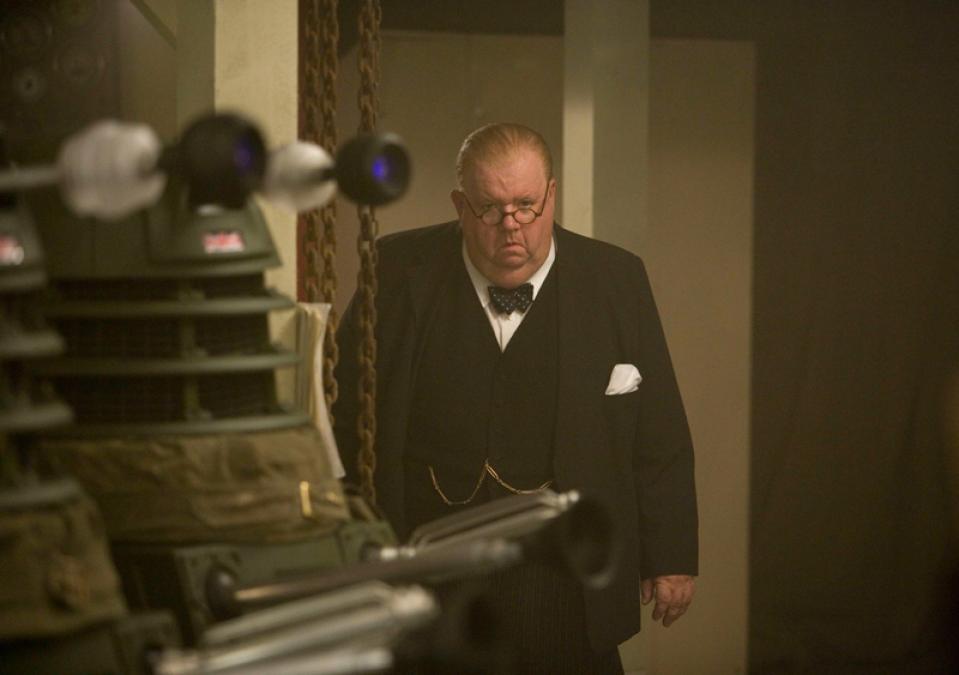
  • The characters this episode are decent enough. Winston Churchill is a caricature spouting out famous quotes when prodded but Ian McNeice plays the part well, and his friendship with the Doctor is great fun to watch, especially when he tries to steal a TARDIS key. Bracewell is hardly the most memorable of characters but has two of the best scenes in the episode - his bomb being defused by his belief that he is human and the final scene where he's delighted to go on living and packs his suitcase to go off and live.
The Valeyard's Case:
  • A bad quotation: "I love me a squaddie." "I am the Doctor, and you are the Daleks!" "Don't mess with me, sweetheart." "Do your worst, Adolf!"
  • The teaser wasn't necessary. We didn't learn anything from it that we couldn't have from the moment of the Doctor and Amy's arrival to the reveal of the Ironsides. If it was just so that that woman could mention her boyfriend in an attempt at world-building and adding an element of emotion, it failed on both accounts. Getting a regular person's perspective on the war and why they might be so blindly willing to trust the Daleks to end it would have been a great addition to the episode. Alas, that wasn't to be.
  • Amy is far too casual in her treatment of both the Daleks and Winston Churchill. Rose was tentative around Metaltron in Dalek and was in awe when she met Queen Victoria; Martha exclaims "what the hell is that?" when she first sees a Dalek in Daleks in Manhattan and is amazed to meet Shakespeare. Just like her successor Clara Oswald, Amy takes things in her stride far too easily. How can the audience be nervous about the Daleks if the companion isn't? How can we care about meeting Winston Churchill if Amy doesn't? 
  • "Have you ever fancied someone you know you shouldn't? Hurts, doesn't it?" Amy fancies the Doctor already? After Grace, Rose, Reinette, Martha, Astrid, Christina and River (and Clara yet to come), it would be more interesting if there was a female who didn't fancy the Doctor. She's supposed to be getting married in the morning and a companion with so few scruples is difficult to like. 
  • I'm one of the few without a strong opinion on the new Dalek designs. They're quite cartoonish, yes, but the speed at which the design is dropped is ridiculous. Moffat could have tried to make them work but chooses to cowardly write them out as much as possible, with them pretty much disappearing after series 5. The new Daleks are introduced, do nothing but stand around in that one room and then retreat. They should have been fearsome and shot up the war chambers or something rather than being entirely impotent on that ship. Because of all of this it's difficult to see Victory of the Daleks as much more than a failure at Dalek marketing. A story that was quickly hushed up and forgotten about.
The Inquisitor's Judgement: As far as Dalek stories go, this is certainly one of the worst. Steven Moffat said in a 2018 interview on the Fan Show that he hadn't given enough attention to the second production block, and it shows. Although Bracewell and Churchill are good guest characters, the plot of this episode is paper-thin and the Daleks are something of a non-threat outside of the small vignettes of them looking suspicious in hallways early on. F


Doctor Who (Series 5)
The Beast Below  Victory of the Daleks  The Time of Angels/Flesh and Stone

Tuesday, 12 September 2017

The Twin Dilemma review [Anthony Steven]


"I am the Doctor, whether you like it or not."
After sacrificing himself to save his companion, the Doctor begins his most unstable regeneration yet, all the while trying to save the galaxy from being infested with alien eggs.

Where are we?: Jaconda, a once lush planet and home to the bird-like Jacondans, devastated by the awakening of the Gastropods.

When are we?: The year 2300, according to the script, picking up right after The Caves of Androzani and a few days before Attack of the Cybermen.

Who are the bad guys?: The slug-like Gastropods, led by Mestor, who plan to destroy Jaconda's sun using the Sylvest twins' equations in order to scatter Gastropod eggs throughout the universe.

The Doctor's Case: 
  • The Doctor makes a few deductive leaps while Lieutenant Lang is unconscious, surmising from his mention of children that a kidnapping for a king's ransom had occurred, but it's nice to see the Doctor being Doctorly.
  • Just as the script says, the Doctor loses all of his self-possession after Peri points out the self-destruct mechanism, making him a far more watchable Doctor.
  • The model work is all pretty good, but the best effect must go to the demise of Mestor, which was achieved using foam and the empty costume. Peter Moffatt found it gruesome enough that he used as little footage of it as possible.
  • Azmael's death is a good showing for the gentler side of the Sixth Doctor, even if Azmael wasn't the most interesting or loveable of characters.
The Valeyard's Case: 
  • The first serial of a new Doctor, for better or worse, leaves an aftertaste for the remainder of their run, be it Spearhead from Space (which served as a fresh start for the show and was the first of an excellent series) or Time and the Rani (a pantomime which the Seventh Doctor was somehow able to recover from). No matter how much you love Colin Baker - and nobody does more than I - nobody can say that this was a great start for the Sixth Doctor. Having the Doctor suffer a traumatic regeneration isn't an inherently flawed idea, but in execution it's not done very well. Having the Doctor attack his companion and blame her whilst their both at gunpoint was perhaps too far. His few seconds of horror and confusion at what he's done are the first glimpse of something beneath the bravado, but then instead of apologising to Peri he condemns her to serve as his disciple during his time as a "weary penitent". He twice calls her a stupid girl and is exceedingly rude to both her and Hugo Lang. The greatest misfire is, of course, his costume. The coat is as Peri describes it "yuck". His trousers, waistcoat and cravat (as seen in the photo above) are entirely mismatched. The costume as a whole makes the Sixth Doctor very difficult to take seriously, especially in the darker direction that the show is steering him in. It's without a doubt the most dated of the Doctor's looks, screaming of the '80s.
  • The sets are terrible in this story. The room the Sylvests are forced to work in aboard the XV773 is abysmal, with one machine seemingly covered in aluminium foil.
  • The Doctor isn't the only one making a poor first impression; in their first scene, Romulus and Remus question that their mother should be deserving of their affections just because she is their mother, calling her a fool and telling their father to buzz off so they can "play equations". Was Anthony Steven trying to make them sound clever? Because they come across as being unlikeable from the off. "Abandoned again", the one sighs.
  • The Doctor drooling over himself and his noble brow in his first scene does nothing to endear us to him and doesn't make us sympathetic to his breakdown in the wardrobe a mere seconds later. It's followed by a cut to Romulus and Remus and then, once we've returned, the Doctor is picking out clothes and acting as though nothing has happened. We should have seen his immediate reaction to the fit rather than quickly returning to him being obnoxious and self-absorbed.
  • The Doctor's little speech upon landing on Titan III about him being a "weary penitent" and falling to his knees is embarrassing.
  • The cliff-hanger from episode one comes out of nowhere - perhaps we should have been given some glimpse of Lang awakening - and is resolved in the laziest manner possible. He simply falls unconscious as quickly as he awoke. The Doctor is prepared to let this policeman die before Peri convinces him otherwise. The cliff-hanger of episode two, with Peri shocked at the Doctor's supposed death, isn't too convincing.
  • Lieutenant Lang choosing to change his jacket very convenient, as he just happens to select the hideous jacket that Peri had previously chosen to hide his gun's power pack in.
  • Lang keeps waving his gun about and making threats, but he isn't remotely threatening.
The Ugly: The Doctor's coat, the costume Peri changes into, Lieutenant Lang's glitzy monstrosity... Mestor and the other Gastropods aren't the best Doctor Who monsters ever seen, but the Jacondons (particularly the Chamberlain) are done pretty well.

A Good Quotation: "In my time I have been threatened by experts and I don't rate you very highly at all."

A Bad Quotation: 
  • "It's the diminutive of my proper name, Perpugilliam."
  • "I'm very, very anxious!" Professor Sylvest says regarding his sons' disappearance.
The Music: The jaunty tune when Peri presents her new outfit is atrocious, but generally the soundtrack isn't too bad or distracting.

Anywhere in Time and Space: In 2300 (as the script dates it), the twins play a two-player game involving moving tall pyramids across a backgammon board. They use a blank square keyboard to write their equations (which look like a glitch in an arcade game) on a screen. People are also still wearing large glasses, as modelled by the Sylvests' father. Warp drive is possible and the police use space ships. Gastropods, figures of Jacondon mythology, are somehow known to at least some Earthlings. Azmael has a Revitaliser which the Doctor was able to alter to allow a small degree of time travel.

His Constant Companion: A number of police ships are shot down. A Jacondon is executed by embolism for stealing vegetables for his starving family. Mestor is killed by the Doctor using acid.

I'll Explain Later: 
  • Exactly what dilemma is this serial named for? There simply isn't one.
  • Why does Mestor call Azmael "Edgeworth" in the first episode? It becomes clear later on that Mestor knows that this is an alias. 
  • What can the Sylvests do that 24th century computers can't?
  • Surely it would have been more sensible for the Doctor or Peri to keep Lang's power pack on their person rather than going to the trouble of hiding it and risking him finding it upon waking?
  • If the Doctor uses the Revitaliser to arrive ten seconds in Peri's future, surely she and Lang should be in the TARDIS. And what does he press in the TARDIS to get him ten seconds in the past?
  • Why does Lang call Azmael "Edgeworth"? He could only have heard about him from the Doctor and Peri, neither of whom know his alias. The Doctor himself later calls him by the same name without any way of him knowing of the alias.
  • The science about moving the lesser planets into Jaconda's orbit making their atmospheres identical and the gravity causing some disaster is just nonsense. Why? I'll explain later.
The Inquisitor's Judgement: The Twin Dilemma is very often voted one of the worst stories in Doctor Who history. It certainly has very little to be praised and doesn't have the best story, characters or acting, but at least it's no worse than Time and the Rani. This serial does the Sixth Doctor a grave disservice, giving him an infinitesimal amount of good material in this script that does nothing to solidify Colin Baker as the Doctor that we know and love. After watching this story for the first time, I had very little hope for the Sixth Doctor. Thank God for Trial of a Time Lord and, more importantly, Big Finish for saving the unlikeable Doctor we met in The Twin DilemmaF


Doctor Who (Season 21)
The Caves of Androzani  The Twin Dilemma  Attack of the Cybermen

Popular posts